
Hamas Consolidates Control in Gaza Amid Trump’s Phase Two Peace Plan
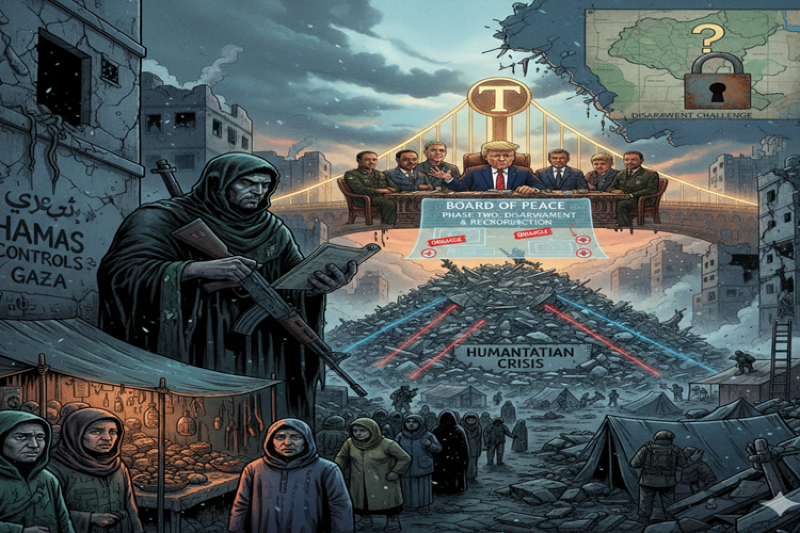
Four months after the US-mediated ceasefire halted the Gaza War last October, Hamas is reasserting its grip over Gaza’s streets, markets, and government services, raising fresh questions about the feasibility of the second phase of President Donald Trump’s peace plan.
Despite heavy losses in the war—over 72,000 Gazans killed according to the Hamas-run health ministry, widespread destruction of infrastructure, and the fracturing of its military units—Hamas appears to be regaining influence over tax collection, policing, and governance. Citizens report routine enforcement of municipal fees and close monitoring of market activity, while the group quietly rebuilds its databases of traders and revenue streams.
"Hamas regained control of more than 90% of the areas where it is present," said activist Mohammed Diab, highlighting the rapid return of security and administrative structures.
Phase Two of Trump’s Peace Plan Faces Obstacles
The next stage of Trump’s plan, focusing on disarmament and reconstruction, hinges on Hamas relinquishing its weapons. The group remains ideologically committed to armed resistance and has so far resisted full disarmament. International negotiators are still debating verification mechanisms, which weapons would be handed over, and the role of the new technocratic council formed to govern Gaza.
U.S. officials, including Special Envoy Steve Witkoff, insist Hamas is under pressure to comply, while Israeli officials emphasize the necessity of disarmament to prevent renewed conflict. Lt Col Nadav Shoshani of the IDF warned that Hamas is rebuilding despite military setbacks and that failure to disarm could trigger renewed Israeli action.
Governance, Aid, and International Oversight
Under Trump’s plan, Gaza’s governance will operate on three layers: a local technocratic council, an executive committee outside Gaza, and the Board of Peace, chaired by Trump. Some foreign leaders, including Indonesia, have offered troops for an International Stabilization Force, but no commitments have been fully formalized.
While aid flows have improved since the ceasefire, hundreds of thousands remain homeless, with winter weather compounding humanitarian challenges. Many Palestinians remain wary of foreign-led governance, fearing a return to a system reminiscent of colonial oversight.
Tensions and Uncertainty Ahead
Even as reconstruction plans take shape, Hamas continues to assert control, including supervising medical evacuations and government appointments. Analysts warn that the delicate ceasefire is fragile, with daily exchanges of fire between Hamas and Israeli forces continuing.
The coming weeks are critical: the success of Trump’s Board of Peace and the international stabilization effort will depend on Hamas’s willingness to cooperate, Israel’s response, and the delicate management of Gaza’s population and infrastructure.
For Gazans, the battle for survival may be shifting from the frontlines to the corridors of power and reconstruction oversight.
Updated Key Points – Gaza & Trump’s Peace Plan
Hamas Regains Control – Four months after the ceasefire, Hamas is extending control over security, markets, taxation, and government services in Gaza.
Heavy War Toll – The conflict left over 72,000 Gazans dead, infrastructure destroyed, and Hamas’ military units fragmented, yet the group is rebuilding influence.
Core Issue – Disarmament – Phase two of Trump’s peace plan requires Hamas to give up weapons, but the group resists, citing ideological commitment and self-defense.
Technocratic Governance – A new local council has been formed to run Gaza’s day-to-day affairs, with oversight from an external Executive Committee and Trump’s Board of Peace.
International Stabilization Force – Proposed multinational force (including Indonesia) remains uncertain, with no full commitment yet.
Aid & Humanitarian Concerns – Aid flows have improved, but hundreds of thousands remain homeless; winter weather and destroyed infrastructure exacerbate the crisis.
Revenue Control – Hamas is quietly restoring tax collection from traders, often using force or coercion to secure payments.
Ongoing Tensions – Ceasefire is fragile; both Hamas and Israel continue low-level attacks, and future compliance is uncertain.
Trump’s Board of Peace – The U.S.-led initiative aims to oversee reconstruction, disarmament, and governance, but faces criticism for centralizing power and potential sidelining of the UN.
Critical Phase Ahead – Success of reconstruction and lasting peace depends on Hamas cooperation, Israel’s security stance, and international oversight.
Key Challenges in Gaza Peace & ReconstructionHamas Disarmament – Hamas refuses to give up weapons, citing ideological commitment and need for self-defense. This is central to moving the peace plan forward.
Governance Transition – Uncertainty over who will actually run Gaza: Hamas, the technocratic council, or the international Executive Committee.
International Stabilization Force – Proposed multinational force (Egypt, Turkey, Indonesia, UAE, Saudi Arabia, Palestinian Authority) lacks full commitment and clarity on deployment.
Fragile Ceasefire – Low-level attacks continue between Hamas and Israel; any breakdown could trigger renewed war.
Humanitarian Crisis – Hundreds of thousands remain homeless, with destroyed infrastructure, winter weather, and insufficient aid.
Revenue & Tax Control – Hamas exerts covert control over trader taxes, sometimes using coercion; this complicates transparency and reconstruction funding.
Israel’s Security Demands – Israel insists on restrictions and partial control; full withdrawal remains uncertain, making local governance difficult.
International Skepticism – Many countries view Trump’s Board of Peace as self-serving, raising questions about legitimacy and effectiveness.
Public Trust & Resistance – Palestinians wary of foreign-controlled governance; suspicion of “colonialism” undermines cooperation with technocrats and external oversight.
Verification of Disarmament – Ensuring all weapons are surrendered and no hidden arsenals remain is practically very difficult.