

Chinese Scientists Develop Seawater Breakthrough to Enable Large-Scale Energy Storage and Supply via Green Hydrogen
GUANGZHOU — A research team in China has achieved a significant milestone in renewable energy by developing a comprehensive framework for industrial-scale hydrogen production directly from seawater. This breakthrough, published in Nature Reviews Clean Technology, bridges the gap between laboratory success and real-world marine application.
While the concept of extracting hydrogen from seawater is not new, the transition to industrial use has long been stalled by the harsh realities of the ocean.
Unlike purified water used in standard electrolysis, raw seawater contains salt, minerals, and organic matter that quickly corrode equipment. Furthermore, the physical environment—marked by constant wave motion and salty sea spray—creates significant engineering hurdles.
The team, led by experts from Sichuan University and Shenzhen University, has moved beyond simple chemical reactions to create a "macroscopic engineering" guide.
Their research establishes a first-of-its-kind evaluation system that accounts for material durability, device configuration, and the unpredictability of offshore renewable energy sources like wind and solar.
Why This Discovery Matters: The Benefits Explained
For the average reader, "direct seawater electrolysis" might sound like dense jargon, but its successful implementation could change the face of global energy. Here is why this discovery is a game-changer:
Preserving Fresh Water: Standard hydrogen production requires massive amounts of highly purified fresh water. This technology allows us to tap into the world’s most abundant resource—the ocean—leaving our limited drinking water supplies untouched.
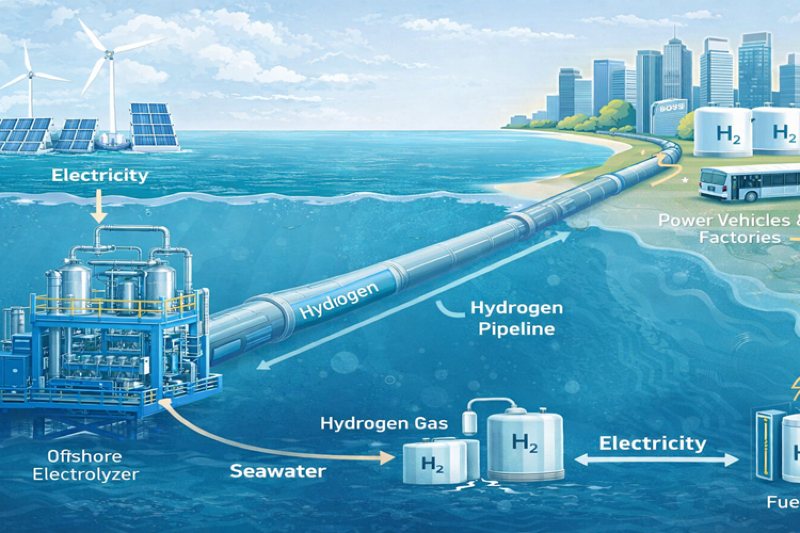
Decentralized Energy Hubs: By producing hydrogen directly at sea, countries can build offshore energy hubs. These hubs can use power from offshore wind farms to create hydrogen on-site, which is then shipped or piped to land, reducing the need for expensive underwater electrical cables.
Cutting Costs and Corrosion: Historically, seawater had to be desalinated (purified) before it could be turned into hydrogen, which is expensive and energy-intensive. This new research provides the "quantifiable benchmarks" needed to build machines that can handle raw seawater directly without breaking down.
Climate Solutions: Hydrogen is a clean fuel that emits only water vapor when burned. By perfecting the "seawater-to-hydrogen" chain, this research provides a theoretical roadmap to mass-produce carbon-free fuel, helping the world reach net-zero emissions faster.
By connecting microscopic science with large-scale engineering, these scientists have provided the "missing link" needed to turn the ocean into a sustainable fuel station for the future.
############
Hydrogen: Not a Source, but a Storage Solution
It’s important to understand that hydrogen does not create energy on its own like windmills or solar panels.
- Wind and Solar = Energy Sources
They capture natural energy and convert it into electricity. - Hydrogen = Energy Carrier (like a battery)
It stores energy so it can be used later or transported elsewhere.
This distinction is key to understanding how the new system works.
The Battery Analogy: Storing Excess Energy
Imagine a wind turbine in the middle of the ocean producing more electricity than needed on a very windy day. Currently, much of this excess energy is wasted.
With the new seawater-based technology:
- The extra electricity is used to split seawater
- This process produces hydrogen gas
- The hydrogen acts like a charged battery, storing energy
When the wind stops blowing, the stored hydrogen can be used to generate electricity again—either by burning it or using fuel cells.
Why This Seawater Breakthrough Matters
Traditionally, producing hydrogen requires clean, fresh water. This adds extra cost and energy because seawater must first be desalinated.
The breakthrough changes that:
- No need for desalination
- Direct use of raw seawater
- Reduced cost and energy consumption
As a result, hydrogen production becomes more efficient and practical, especially in ocean-based renewable setups.
From Ocean to City: Moving Energy Efficiently
One of the biggest challenges of renewable energy is location. Wind farms and solar plants are often far from cities.
Hydrogen solves this problem:
- Electricity is converted into hydrogen at sea
- Hydrogen is stored in tanks or pipelines
- It is transported to cities for use in:
- Vehicles (cars, buses)
- Factories
- Power generation
Unlike electricity, hydrogen can be physically moved, making it a flexible energy solution.
Conclusion: A Powerful Partnership
This innovation does not replace renewable energy sources—it enhances them.
- Wind and solar generate the energy
- Seawater technology converts it into hydrogen fuel
- Hydrogen stores and transports that energy
Together, they create a more reliable, efficient, and scalable clean energy system, turning the ocean into a vast renewable fuel hub. GUANGZHOU — A research team in China has achieved a significant milestone in renewable energy by developing a comprehensive framework for industrial-scale hydrogen production directly from seawater. This breakthrough, published in Nature Reviews Clean Technology, bridges the gap between laboratory success and real-world marine application. While the concept of extracting hydrogen from seawater is not new, the transition to industrial use has long been stalled by the harsh realities of the ocean. Unlike purified water used in standard electrolysis, raw seawater contains salt, minerals, and organic matter that quickly corrode equipment. Furthermore, the physical environment—marked by constant wave motion and salty sea spray—creates significant engineering hurdles. The team, led by experts from Sichuan University and Shenzhen University, has moved beyond simple chemical reactions to create a "macroscopic engineering" guide. Their research establishes a first-of-its-kind evaluation system that accounts for material durability, device configuration, and the unpredictability of offshore renewable energy sources like wind and solar. For the average reader, "direct seawater electrolysis" might sound like dense jargon, but its successful implementation could change the face of global energy. Here is why this discovery is a game-changer: Preserving Fresh Water: Standard hydrogen production requires massive amounts of highly purified fresh water. This technology allows us to tap into the world’s most abundant resource—the ocean—leaving our limited drinking water supplies untouched. Decentralized Energy Hubs: By producing hydrogen directly at sea, countries can build offshore energy hubs. These hubs can use power from offshore wind farms to create hydrogen on-site, which is then shipped or piped to land, reducing the need for expensive underwater electrical cables. Cutting Costs and Corrosion: Historically, seawater had to be desalinated (purified) before it could be turned into hydrogen, which is expensive and energy-intensive. This new research provides the "quantifiable benchmarks" needed to build machines that can handle raw seawater directly without breaking down. Climate Solutions: Hydrogen is a clean fuel that emits only water vapor when burned. By perfecting the "seawater-to-hydrogen" chain, this research provides a theoretical roadmap to mass-produce carbon-free fuel, helping the world reach net-zero emissions faster. By connecting microscopic science with large-scale engineering, these scientists have provided the "missing link" needed to turn the ocean into a sustainable fuel station for the future.Why This Discovery Matters: The Benefits Explained
Chinese Scientists Unlock Blueprint for Large-Scale Green Hydrogen from Seawater
GUANGZHOU — A research team in China has achieved a significant milestone in renewable energy by developing a comprehensive framework for industrial-scale hydrogen production directly from seawater. This breakthrough, published in Nature Reviews Clean Technology, bridges the gap between laboratory success and real-world marine application.
While the concept of extracting hydrogen from seawater is not new, the transition to industrial use has long been stalled by the harsh realities of the ocean. Unlike purified water used in standard electrolysis, raw seawater contains salt, minerals, and organic matter that quickly corrode equipment. Furthermore, the physical environment—marked by constant wave motion and salty sea spray—creates significant engineering hurdles.
The team, led by experts from Sichuan University and Shenzhen University, has moved beyond simple chemical reactions to create a "macroscopic engineering" guide. Their research establishes a first-of-its-kind evaluation system that accounts for material durability, device configuration, and the unpredictability of offshore renewable energy sources like wind and solar.
Why This Discovery Matters: The Benefits Explained
For the average reader, "direct seawater electrolysis" might sound like dense jargon, but its successful implementation could change the face of global energy. Here is why this discovery is a game-changer:
Preserving Fresh Water: Standard hydrogen production requires massive amounts of highly purified fresh water. This technology allows us to tap into the world’s most abundant resource—the ocean—leaving our limited drinking water supplies untouched.
Decentralized Energy Hubs: By producing hydrogen directly at sea, countries can build offshore energy hubs. These hubs can use power from offshore wind farms to create hydrogen on-site, which is then shipped or piped to land, reducing the need for expensive underwater electrical cables.
Cutting Costs and Corrosion: Historically, seawater had to be desalinated (purified) before it could be turned into hydrogen, which is expensive and energy-intensive. This new research provides the "quantifiable benchmarks" needed to build machines that can handle raw seawater directly without breaking down.
Climate Solutions: Hydrogen is a clean fuel that emits only water vapor when burned. By perfecting the "seawater-to-hydrogen" chain, this research provides a theoretical roadmap to mass-produce carbon-free fuel, helping the world reach net-zero emissions faster.
By connecting microscopic science with large-scale engineering, these scientists have provided the "missing link" needed to turn the ocean into a sustainable fuel station for the future.