

China Set to Launch Chang'e-7 Lunar Mission in Late 2026: A Deep Dive into the South Pole Expedition and the Road to a 2030 Human Habitat
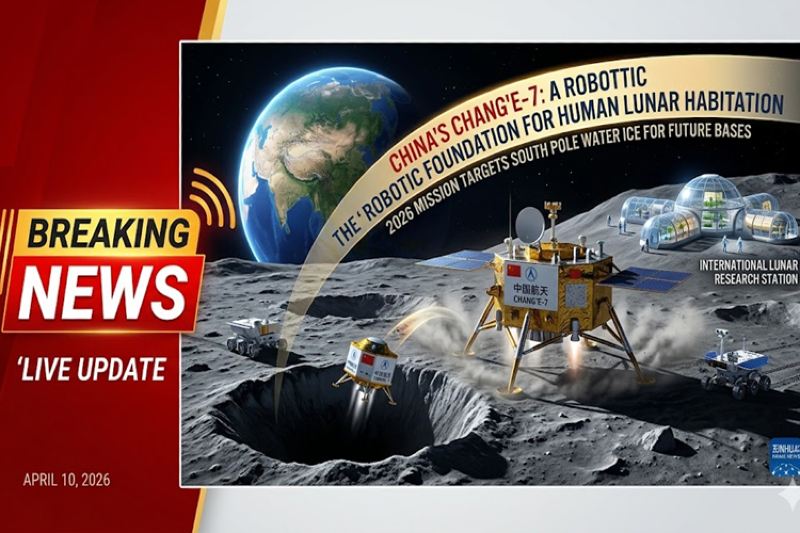
WENCHANG, Hainan — China is officially entering the next phase of its ambitious lunar program. The China Manned Space Agency (CMSA) confirmed on Friday that the Chang'e-7 lunar probe is scheduled for launch in the second half of 2026.
The spacecraft has already arrived at the Wenchang Spacecraft Launch Site in Hainan Province. According to official reports, the facility is in optimal condition, and engineers are beginning a rigorous battery of pre-launch tests to ensure the mission remains on its planned trajectory.
Mission Objectives: High-Tech Exploration of the Lunar South Pole
The Chang'e-7 mission is not merely a landing; it is a complex technological demonstration designed to conquer the rugged terrain of the lunar south pole. The mission will focus on several "breakthrough" technologies:
Precision Landings: Implementing high-precision soft-landing capabilities to navigate the treacherous southern lunar landscape.
Multi-Modal Mobility: The mission will utilize a combination of rovers, legged movement, and hopping mechanisms.
Shadowed Crater Exploration: A primary goal is the investigation of permanently shadowed craters, which scientists believe may hold key resources like water ice.
A Four-Pronged Strategy
Unlike traditional lunar missions that rely on a single vehicle, Chang'e-7 will employ a comprehensive "four-in-one" detection strategy:
Orbiter: To map the surface and provide communication relays.
Lander: To serve as the primary touchdown vehicle.
Rover: To traverse the lunar surface for resource surveying.
Hopper: A specialized craft designed to "hop" into craters and areas difficult for wheeled rovers to reach.
Global Collaboration and Future Ambitions
In a move toward "open science," China has confirmed that international cooperation will be integrated into the Chang'e-7 mission. By collaborating with global partners, the mission aims to share data and enhance the collective understanding of lunar resources.
Furthermore, the CMSA highlighted a new era of integration within China's space sector. The country plans to merge the technical capabilities of its unmanned robotic probes with its crewed lunar landing program. This synergy is expected to maximize the efficiency of future missions as China moves toward a sustainable human presence on the Moon.
How the Chang’e-7 Mission Redefines Lunar Exploration?
The Chang'e-7 mission represents a significant leap from China’s previous lunar voyages (like Chang'e-5 and Chang'e-6) and even differs fundamentally from current Western missions like Artemis II.
While prior missions focused on "seeing" the Moon or "bringing it back" (sampling), Chang'e-7 is about "living" and "utilizing" its resources.
1. Unique Tech: The "Mini-Hopper"
The most striking dissimilarity is the inclusion of a mini-flying probe (hopper).
Previous Voyages: Relied on wheeled rovers (like Yutu-2), which are limited by craters and rough rocks.
Chang'e-7: This "hopper" can take off and land multiple times.
It will "jump" from sunlit areas into permanently shadowed craters where rovers cannot go, specifically to search for water ice.
2. Extreme Precision Landing
Previous Voyages: Landing "ellipses" (the target zone) were often several kilometers wide.
Chang'e-7: Aims for a precision of better than 100 meters.
This is necessary because the Lunar South Pole has "peaks of eternal light" and "craters of eternal darkness" right next to each other. Landing in the wrong spot could mean your solar panels never see the sun.
3. Mission Complexity: A "Four-in-One" Fleet
Most lunar missions consist of an orbiter and a lander. Chang'e-7 is a massive "robotic powerhouse" with four distinct components working in sync:
Orbiter: High-resolution mapping.
Lander: The base station.
Rover: Wide-area exploration.
Hopper: The "scout" for inaccessible craters.
4. Direct Contrast with Chang'e-6 and Artemis II
| Feature | Chang'e-6 (2024) | Chang'e-7 (2026) | Artemis II (2025/26) |
|---|---|---|---|
| Primary Goal | Sample return from the Far Side. | Resource mapping (Water Ice). | Crewed Lunar Flyby. |
| Target | South Pole-Aitken Basin. | Shackleton Crater (South Pole). | Lunar Orbit (No Landing). |
| Nature | Robotic - "Collect & Leave." | Robotic - "Explore & Stay." | Human - "Test & Return." |
| Energy Source | Traditional Solar. | Vertical Solar Panels (optimized for low-angle polar sun). | Nuclear/Solar mix. |
5. Shift to "In-Situ Resource Utilization" (ISRU)
Unlike Chang'e-5, which treated the Moon as a scientific subject to be studied in a lab on Earth, Chang'e-7 treats the Moon as a potential gas station.
The Goal: Confirm if water ice can be converted into oxygen for breathing and hydrogen for rocket fuel.
The Difference: This voyage is the foundation for the International Lunar Research Station (ILRS)—China's plan for a permanent human base by the 2030s.
Key Takeaway: If Chang'e-5 was a "tourist" taking photos and souvenirs, and Chang'e-6 was a "geologist" digging in remote areas, Chang'e-7 is the "engineer" scouting for the best spot to build a house and a well.
Why the Lunar South Pole Matters
The South Pole has become the new frontier for space-faring nations. The presence of water ice in its deep craters could provide life support and fuel for future deep-space missions. Chang'e-7’s mission to survey these environmental resources is a critical step in determining the feasibility of long-term lunar bases.
Quick Mission Facts:
Launch Date: Second half of 2026
Launch Site: Wenchang, Hainan
Target: Lunar South Pole
Key Tech: Hopping probes and high-precision landing.