
China Drops 19 Lawmakers, Including Nine Military Officers, Ahead of Annual ‘Two Sessions’
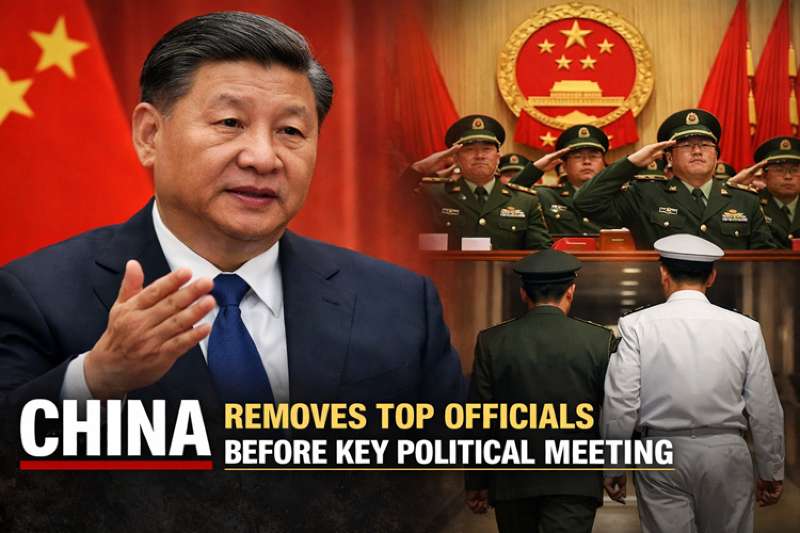
China’s top legislature has removed 19 individuals — including nine senior military officers — from its roster of national lawmakers just days before the country’s most significant annual political gathering.
The decision was announced by the Standing Committee of the National People’s Congress (NPC), China’s highest legislative authority.
While no detailed explanation accompanied the move, it comes amid renewed scrutiny of the military establishment and broader efforts to reinforce party discipline.
Among those removed are Li Qiaoming, commander of the People’s Liberation Army (PLA) Ground Force, and Shen Jinlong, former commander of the PLA Navy.
Several other senior officers and provincial-level officials were also taken off the list, including Sun Shaochong, the former Communist Party chief of the Inner Mongolia Autonomous Region.
The development follows a series of high-profile dismissals within the armed forces. In recent years, multiple senior generals have been investigated or removed, often under accusations of “serious violations of discipline and law” — a phrase commonly used in China to denote corruption-related offenses.
Since assuming power in 2013, President Xi Jinping has made anti-corruption enforcement a defining feature of his leadership. Under his widely publicized “tigers and flies” campaign, both top-ranking officials and lower-level cadres have faced investigations.
Xi has repeatedly described corruption as one of the most serious threats to the ruling Communist Party, while critics argue that the campaign has also served to sideline political rivals.
The latest removals come ahead of the annual “Two Sessions,” a key political event held in Beijing that brings together thousands of delegates from across the country. The gatherings include the sessions of the National People’s Congress and the Chinese People’s Political Consultative Conference (CPPCC), the nation’s top political advisory body.
Scheduled to run from March 4 to 11, the meetings are expected to outline major policy priorities, economic targets, and strategic objectives for the coming year, as well as broader development goals under China’s ongoing five-year planning framework.
The timing of the latest changes suggests continued consolidation within China’s political and military structures as the leadership prepares to set the national agenda for the year ahead.
Side story
In February 2026, the CIA launched a cinematic Mandarin-language recruitment campaign titled "The Reason for Stepping Forward: To Save the Future," specifically engineered to exploit growing friction within the People’s Liberation Army (PLA).
The campaign features high-production videos depicting a fictional, mid-level Chinese military officer who becomes disillusioned after witnessing rampant corruption and the "ruthless elimination" of competent leaders in favor of political loyalists.
By framing espionage as an act of patriotism—suggesting that sharing secrets is a way to "fight for family and country" against "madmen" leaders—the agency aims to capitalize on the internal instability following high-profile purges like that of General Zhang Youxia.
To bypass China’s "Great Firewall," the campaign includes explicit, step-by-step instructions on how to use the Tor browser and other encrypted channels to contact U.S. intelligence securely, marking a significant and public escalation in the ongoing "shadow war" between Washington and Beijing.