
Berlin Sounds Economic Alarm as China Imports Surge
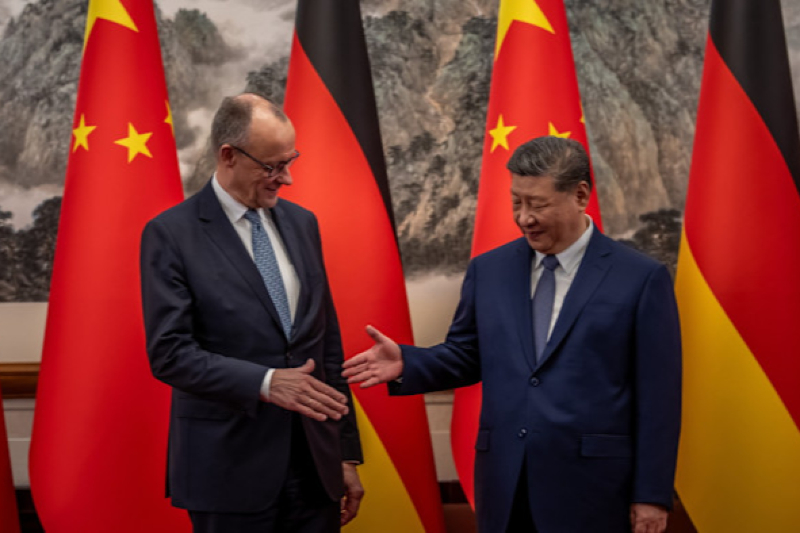
On his inaugural trip to Beijing, German Chancellor Friedrich Merz delivered a blunt message: the growing trade imbalance between Germany and China is “not healthy” and must be addressed before it further weakens Europe’s largest economy.
Speaking after high-level meetings with Chinese leaders, Merz underscored the urgency of narrowing a deficit that has widened dramatically in recent years. Official data show that in 2025 Germany imported €170.6 billion worth of goods from China—an 8.8% increase from the previous year—while exports to China fell nearly 10% to €81.3 billion. The gap has now more than quadrupled over the past five years.
Trade Imbalance Raises Alarm in Berlin
China reclaimed its position as Germany’s top trading partner in 2025, overtaking the United States. But behind the headline figure lies a stark imbalance that economists warn could erode the foundation of German industry.
Sectors such as automobiles, machinery, and chemicals—long regarded as the backbone of Germany’s export-driven economy—are feeling the strain. Analysts argue that a surge of competitively priced Chinese goods is squeezing European manufacturers at a time when energy costs and global uncertainty are already weighing heavily.
Merz acknowledged the complexity of the situation, saying he aims to find “ways to reduce this trade deficit” without triggering unnecessary confrontation. “We want to strengthen our partnership, but we will of course also protect our interests,” he told reporters.
Subsidies, Currency and the “China Shock”
Economists in Germany have attributed the imbalance in part to what they describe as extensive Chinese state subsidies and currency policies that benefit exporters. Beijing, however, has repeatedly rejected such claims, insisting its policies comply with international trade rules and are based on market principles.
Think tanks in Brussels have pointed to broader global dynamics as well. The pandemic and Russia’s war in Ukraine drove up European production costs, while China entered a prolonged period of deflation fueled by industrial overcapacity. The result has been a wave of lower-priced exports reaching European markets—an effect some analysts are calling the latest “China shock.”
Business Delegation and Strategic Stakes
Merz’s visit included a large delegation of German business leaders eager to stabilize ties while ensuring fair competition. Industry groups have urged Berlin to confront issues ranging from market distortions to export controls on critical raw materials such as rare earth elements.
In a positive development, China signaled plans to purchase up to 120 aircraft from Airbus, offering a boost to Europe’s aviation sector. Yet broader concerns remain, particularly in the automotive industry, where Germany faces mounting competition from Chinese electric vehicle manufacturers.
Europe’s Balancing Act
The European Union has already initiated several anti-dumping investigations and is debating stronger trade defense measures. However, policymakers are cautious. As global trade tensions intensify—especially amid shifting U.S. tariff strategies—European leaders are wary of being caught between the world’s two largest economies.
Merz also used the trip to urge Beijing to leverage its influence over Moscow to help bring an end to the war in Ukraine, highlighting the geopolitical dimension of the economic relationship.
A Turning Point for Germany’s China Policy?
For years, Germany pursued a strategy of deep economic engagement with China under the banner of “change through trade.” That approach now faces renewed scrutiny as dependencies built over decades prove difficult to unwind.
Merz stopped short of advocating economic decoupling, calling such a move a mistake. Instead, he signaled a recalibration—maintaining cooperation while guarding strategic interests.
As Germany grapples with sluggish growth and industrial restructuring, the outcome of this recalibration could shape not only Berlin’s economic future but also Europe’s broader stance toward Beijing.