MADRID, Spain, October 28: At least 68 people have died and dozens more have been injured after two high-speed passenger trains collided in central Spain, triggering a major rescue operation and raising serious concerns about railway safety and traffic management.
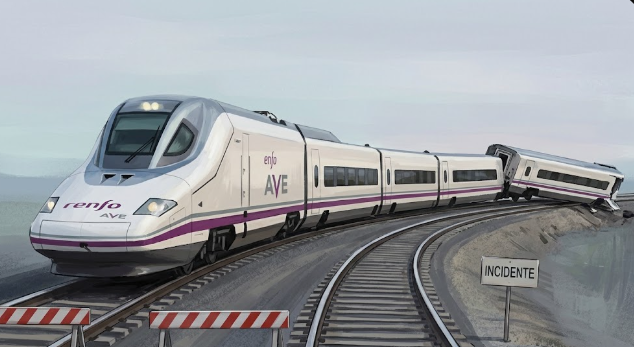
The collision occurred near Urda, in Toledo province, south of Madrid, when a Renfe AVE high-speed train struck the rear of a stationary train operated by private railway company Iryo.
More than 500 passengers were travelling aboard the two trains, making the accident Spain's deadliest railway disaster since 2013.
Prime Minister Pedro Sánchez visited the crash site and expressed profound sorrow over the loss of life, saying the entire country was mourning the victims.
He pledged a thorough investigation to establish the circumstances behind the collision and determine who should be held accountable.
Computer Failure and Control Centre Decision Under Scrutiny
Spanish Transport Minister Óscar Puente said preliminary findings indicated that a computer malfunction had disrupted railway operations shortly before the collision.
The technical failure reportedly forced at least six trains operating in the area to stop temporarily.
However, railway traffic controllers subsequently authorised one of the affected trains to resume its journey despite another train remaining stationary on the same track.
Puente questioned the decision, describing it as difficult to explain based on the information available to investigators.
The minister suggested that human error may have played a significant role, although the official investigation has yet to establish a definitive cause.
Investigators are examining communications between the railway control centre and train operators to determine why the approaching service was permitted to proceed.
Spanish media have also reported that Guardia Civil officers are questioning personnel who were working at Madrid's Atocha railway control centre when the collision occurred.
High-Speed Train Struck Stationary Passenger Service
According to the reported sequence of events, Iryo train 6076 departed Madrid Atocha station at approximately 7:54 a.m. with 147 passengers.
Renfe AVE train 2080 followed at around 8:00 a.m., carrying approximately 397 passengers.
Shortly before 9:00 a.m., the Renfe train collided with the rear of the stationary Iryo service.
The impact derailed several carriages, leaving sections of both trains severely damaged. Some carriages reportedly plunged down an embankment, complicating rescue operations.
Authorities are investigating the speed of the approaching train and whether the driver received appropriate warnings about the obstruction ahead.
Railway safety procedures generally require trains operating under restricted visibility or uncertain track conditions to travel at a speed that allows them to stop safely.
Officials are examining whether those requirements were properly communicated and followed.
Survivors Describe Terrifying Moments
Passengers who survived the collision described scenes of panic, destruction and desperate attempts to escape damaged carriages.
Salvador Arriza, 62, who was travelling on the Renfe service, said passengers smashed windows to escape after the violent impact.
He described badly damaged seating and passengers trapped among the wreckage.
Another survivor, Rafael Barceló, said he was having breakfast in the train's cafeteria when the collision occurred.
The force of the impact threw passengers from their positions, leaving several injured.
Barceló said he escaped with comparatively minor injuries, although a companion was more seriously hurt.
He also reported seeing multiple fatalities in one of the most severely damaged carriages.
Spanish journalist Roberto Gómez, who was travelling aboard one of the trains, described the aftermath as deeply distressing and chaotic.
Hundreds of Emergency Workers Deployed
Spanish authorities launched a large-scale emergency response involving police, medical teams, firefighters and civil protection personnel.
According to the Interior Ministry, 422 Guardia Civil personnel and 102 civil protection and emergency officials were deployed to the disaster site.
Three helicopters, drones and specially trained search dogs were also mobilised to support rescue and recovery operations.
Emergency crews worked through the evening under powerful floodlights as heavy machinery was brought in to remove damaged railway components and reach inaccessible sections of the wreckage.
A large crane was used to lift debris, including damaged train equipment, while investigators continued examining the crash scene.
Authorities confirmed that the bodies of 68 victims had been recovered, while dozens of injured passengers required medical assistance.
Transport Minister Faces Calls to Resign
The disaster has triggered growing political pressure on Spain's transport authorities.
The Spanish trade union CSIF demanded the resignation of Transport Minister Óscar Puente, accusing him of attempting to shift responsibility onto railway traffic management personnel.
The union argued that the government should accept responsibility for the wider circumstances surrounding the accident, particularly the computer failure that preceded the collision.
Meanwhile, demonstrators gathered outside the Ministry of Transport and Sustainable Mobility in Madrid, demanding accountability for the deaths.
Some protesters carried Spanish flags and displayed banners condemning the country's political leadership.
The growing public anger reflects concerns over how such a catastrophic collision could occur on a modern high-speed railway network equipped with advanced signalling and train control systems.
Political Campaigning Suspended as Nation Mourns
The tragedy has also disrupted Spain's political calendar, with several major parties suspending general election campaign activities as a mark of respect for the victims.
Prime Minister Sánchez assured the public that the investigation would seek to establish the full sequence of events and identify any technical, operational or human failures.
The collision has renewed debate over railway safety standards, infrastructure reliability and the responsibilities of train operators and centralised traffic controllers.
Investigators are expected to examine electronic signalling records, train operating data, communications logs and decisions made by control centre staff.
The findings could have significant implications for Spain's railway safety procedures and the management of its extensive high-speed rail network.
As families await further information about their loved ones, emergency personnel continue their work at the crash site, while Spain confronts one of the darkest chapters in its recent railway history.