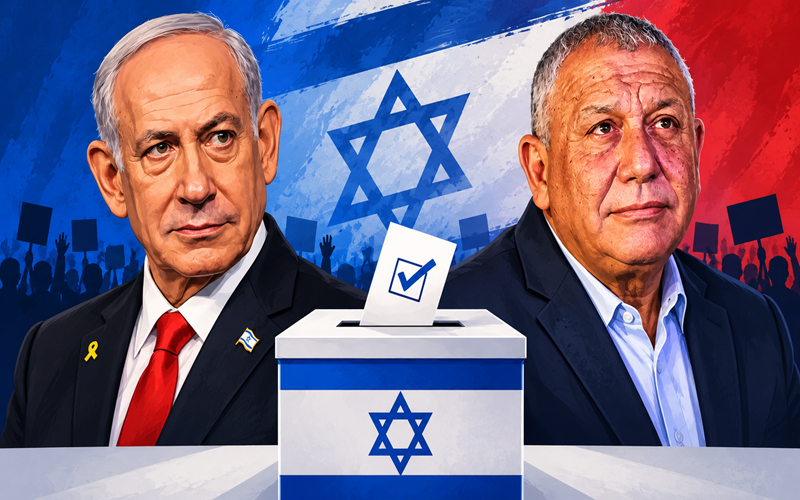
JERUSALEM, October 27, 2026: Israelis are voting in a closely fought parliamentary election that could determine Prime Minister Benjamin Netanyahu's political future, with national security, the Gaza war, military conscription and judicial reforms dominating the campaign.
Netanyahu, Israel's longest-serving prime minister, faces a major challenge from former military chief Gadi Eisenkot, whose newly established centrist Yashar party has emerged as a leading force in the opposition.
Opinion polls published ahead of Tuesday's election suggest a competitive race between the two political camps. However, neither Netanyahu's alliance nor the parties seeking to replace him appear assured of securing the 61 seats required for a majority in the 120-member Knesset.
The outcome could therefore depend on negotiations among political parties after voting concludes, potentially prolonging uncertainty over the formation of the next government.
October 7 Attacks Dominate Election Campaign
National security has remained central to the election, particularly the Israeli government's handling of the Hamas-led attacks on October 7, 2023.
Nearly 1,200 people were killed and 251 were taken hostage during the attacks, which triggered Israel's prolonged military campaign in the Gaza Strip.
Opposition leaders have accused Netanyahu's government of failing to prevent the assault and have demanded an independent state commission of inquiry to establish responsibility for the security failures.
Netanyahu has resisted proposals for such an investigation, arguing that the process could be politically biased.
The prime minister has instead emphasized Israel's military operations across the Middle East, presenting his leadership as essential to confronting regional security threats.
He has also highlighted his relationship with US President Donald Trump as an important element of Israel's diplomatic and strategic position.
Eisenkot Emerges as Major Political Challenger
Eisenkot, a former chief of staff of the Israeli military, has become one of Netanyahu's most prominent electoral rivals.
His Yashar party is part of a broader opposition grouping whose members differ on several ideological issues but share an interest in replacing the current government.
Other significant opposition figures include former Prime Minister Naftali Bennett, former Defence Minister Avigdor Lieberman and former general Yair Golan.
Bennett and Lieberman represent right-wing political traditions, while Golan leads a left-leaning political movement.
Their differences over security, domestic policy and potential coalition partners could complicate efforts to establish an alternative government.
Netanyahu, meanwhile, is seeking to retain power through an alliance involving his Likud party, far-right factions and ultra-Orthodox religious parties.
Among his political partners are parties led by Itamar Ben-Gvir and Bezalel Smotrich, who have played prominent roles in the outgoing administration.
Coalition Negotiations Could Determine Next Government
Israel's proportional representation system makes coalition-building a decisive part of national elections.
Political parties compete for seats in the Knesset, and a prospective prime minister must secure sufficient parliamentary support to form a government.
Recent polling has suggested that neither of the main political camps is guaranteed a majority.
This could place smaller parties in a potentially influential position during post-election negotiations.
Arab political parties may also become important to the parliamentary calculations.
Arab citizens account for approximately one-fifth of Israel's population, and their political representatives could influence the balance of power if the principal Jewish-led alliances fall short of a majority.
However, several leading parties have rejected cooperation with Arab factions, limiting possible coalition arrangements.
Lieberman has ruled out joining a government dependent on support from Arab parties, adding another complication to the opposition's efforts to assemble a governing majority.
Judicial Reforms and Corruption Trial Remain Contentious
Beyond security, the election has renewed debate over the independence of Israel's judiciary and the balance of power between elected officials and the courts.
Netanyahu's government has pursued controversial changes to the judicial system, proposals that prompted widespread demonstrations before the October 2023 attacks.
Critics argue that the measures could weaken judicial oversight and reduce checks on executive authority.
Supporters maintain that changes are necessary to address what they regard as excessive judicial influence over decisions made by elected representatives.
Netanyahu also continues to face a corruption trial involving allegations that he has repeatedly denied.
The legal proceedings and proposed judicial changes have featured prominently in the opposition's criticism of his leadership.
Iran Tensions Surface in Final Campaign Days
Israel's confrontation with Iran has also featured in the final stages of the campaign.
Israeli media reported allegations that Netanyahu had sought military action that could lead to renewed confrontation with Tehran shortly before the election.
Channel 12 reported that military chief Eyal Zamir opposed a proposal that could have triggered further hostilities.
CNN separately reported that Netanyahu had attempted to persuade Trump to authorize additional strikes against Iran, but that the US president declined.
Netanyahu denied both reports.
The prime minister also attracted attention after sharing an AI-generated image depicting a nuclear explosion in Tel Aviv while warning about the potential consequences of Iran acquiring nuclear weapons.
Eisenkot criticized the prime minister's approach, describing him as "hysterical."
The exchanges illustrated the central role of regional security concerns in the election campaign.
Military Conscription Divides Israeli Society
Another major issue concerns military service exemptions for ultra-Orthodox Jewish men engaged in full-time religious studies.
The Israeli Supreme Court has ruled against the continuation of certain exemptions, but Netanyahu's government has faced criticism over its handling of the matter.
The controversy has intensified during the prolonged conflicts involving Israeli forces, with many other citizens required to serve in the military.
Ultra-Orthodox political parties, which have supported Netanyahu's governing coalition, have strongly opposed efforts to expand compulsory military service within their communities.
The dispute has become a significant source of tension between religious groups, secular Israelis and military families.
Opposition leaders have argued for changes to the existing arrangements, presenting the issue as one of equality in sharing national responsibilities.
Gaza War and Palestinian Future Remain Major Challenges
The election is taking place against the backdrop of the continuing humanitarian and political consequences of the Gaza war.
Israeli forces have carried out repeated strikes in Gaza despite a ceasefire agreement reached last year, saying their operations target Hamas members.
According to Gaza's health ministry, more than 74,000 Palestinians have been killed since the beginning of the conflict. The United Nations has generally regarded the ministry's casualty reporting as reliable.
Israel has faced substantial international criticism over the conduct of its military campaign, while relations with several longstanding allies have come under strain.
Eisenkot has taken a firm position on Hamas, pledging to end the group's rule in Gaza within 18 months.
He has indicated that this objective could be pursued through a US-led peace initiative or military action if diplomatic efforts fail.
His position on Gaza therefore shares some similarities with Netanyahu's security approach, despite their political rivalry.
On the occupied West Bank, Eisenkot generally supports Israeli settlements but has called for stronger action against extremist settlers involved in attacks on Palestinians.
The United Nations has documented increasing settler violence in the territory.
Israeli settlements in the occupied West Bank are considered illegal under international law, although Israel disputes aspects of that legal position.
Eisenkot has also discussed the possibility of limited Palestinian self-government under continued Israeli security control.
However, the prospect of an independent Palestinian state existing alongside Israel has received relatively little support among the principal Jewish political parties during the campaign.
Political Uncertainty Beyond Election Day
The election could reshape Israel's domestic politics and influence its approach to regional conflicts, relations with Washington and diplomatic engagement with other countries.
Yet the final result may not immediately determine who becomes prime minister.
Even if one party wins more parliamentary seats than its rivals, forming a government will depend on securing the support of other political factions.
Disagreements over Arab party participation, religious exemptions, judicial reforms and security policy could complicate coalition negotiations.
With the major political blocs divided and smaller parties potentially holding decisive seats, Israel faces the possibility of an extended period of negotiations before a new government can take office.
For voters, Tuesday's election presents a choice between competing approaches to leadership, security and governance at a time when the country continues to confront the consequences of prolonged conflict and deep political divisions.