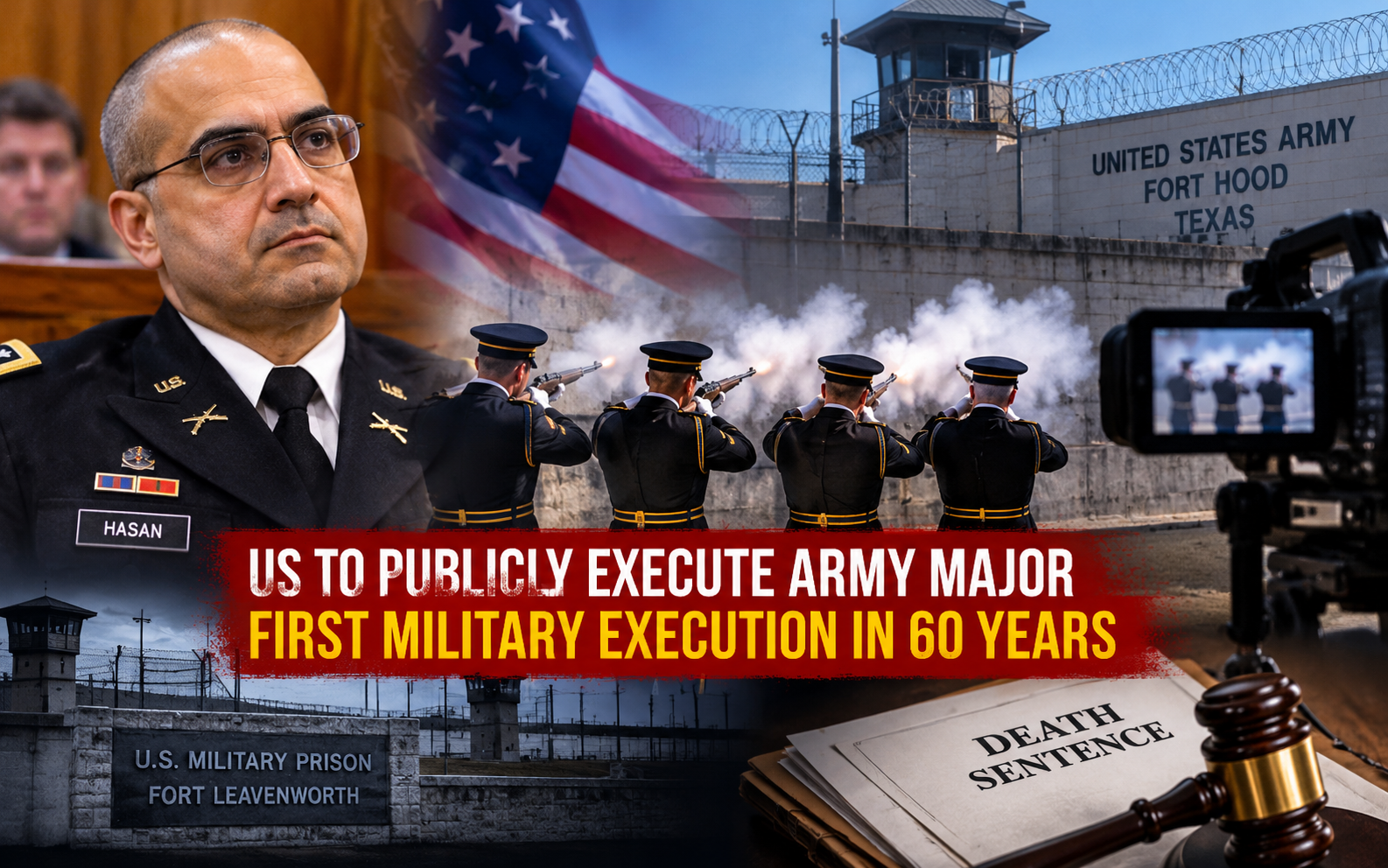
WASHINGTON, October 9 — The United States military plans to livestream the execution of former Army Major Nidal Malik Hasan, who was convicted of killing 13 people in a mass shooting at Fort Hood, Texas, in 2009, marking the first US military execution in more than six decades.
The Pentagon confirmed that Hasan, a former military psychiatrist, is scheduled to face a firing squad on December 3 at Fort Hood. If carried out, it would also be the first execution by a US military firing squad since 1945.
US Defence Secretary Pete Hegseth announced on Thursday that the execution would be made available for public viewing, arguing that severe crimes must carry serious consequences. A Pentagon official subsequently confirmed that the proceedings would be broadcast live, although the government has not disclosed which platform would carry the transmission.
Hegseth said the execution would take place at 1pm local time, deliberately matching the approximate time and location of the deadly attack 17 years earlier.
Trump Approves Death Sentence
President Donald Trump approved Hasan's death sentence on October 2 following a recommendation from the defence secretary and the completion of the military appellate process.
Acting Secretary of the Army Adam Telle formally directed the execution on October 6, setting December 3 as the date.
According to an official US Army statement, military regulations require an execution to be scheduled between 60 and 150 days after presidential approval.
The US Supreme Court declined to review Hasan's military conviction in March 2025, clearing an important legal obstacle to carrying out the sentence.
Hasan has been held at the US military prison at Fort Leavenworth, Kansas, since receiving his death sentence in 2013.
Deadly Fort Hood Shooting
On November 5, 2009, Hasan opened fire inside a crowded military processing facility at Fort Hood, where soldiers were undergoing medical examinations and preparing for overseas deployment.
The shooting killed 12 soldiers and one civilian and injured 32 others, making it one of the deadliest attacks at an American military installation.
Hasan was wounded by responding police officers and subsequently arrested. The injuries left him paralysed from the waist down.
A military court convicted him in August 2013 of 13 counts of premeditated murder and 32 counts of attempted murder. He was sentenced to death later that month.
During his court-martial, Hasan acknowledged carrying out the shooting and linked his actions to his opposition to US military operations in Afghanistan.
Investigators also established that he had exchanged emails with Anwar al-Awlaki, a radical cleric who was later killed in an American drone strike.
Public Broadcast Raises Legal and Ethical Questions
The Pentagon's decision to livestream the execution has generated controversy among legal experts, particularly because the United States has no modern precedent for broadcasting a judicial execution to the general public.
Military regulations provide for selected witnesses, including representatives of the news media, but questions remain about how an unrestricted public broadcast would comply with existing procedures.
Some legal specialists have warned that turning an execution into a widely accessible broadcast could create a public spectacle rather than serve the interests of justice.
Others argue that allowing citizens to observe an execution could increase transparency about how the government administers capital punishment.
John Galligan, an attorney who previously represented Hasan, has raised concerns about the procedures surrounding the announcement and the prisoner's access to legal advice.
Legal experts have also suggested that further proceedings in federal courts could delay the execution, despite the completion of Hasan's military appeals.
The Army maintains that the sentence was approved through the required legal process.
First Military Execution Since 1961
The last execution carried out by the US military occurred in 1961, when Army Private John Bennett was hanged following his conviction for the rape and attempted murder of an 11-year-old girl in Austria.
The military's last execution by firing squad took place in 1945, when Private Eddie Slovik was executed for desertion during World War II.
Although civilian executions have continued in several American states, military executions have remained exceptionally rare.
The planned execution of Hasan would therefore end a 65-year period without an execution under the US military justice system.
Debate Over Capital Punishment
The announcement comes amid renewed debate over the death penalty under the Trump administration, which has taken steps to expand its use at the federal level.
Supporters of the execution argue that Hasan's crimes warrant the most severe punishment and that the decision could provide a measure of closure for survivors and relatives of those killed.
Critics have questioned the government's decision to make the execution publicly accessible, warning that it could raise serious concerns about dignity, legal safeguards and the purpose of capital punishment.
For now, the Pentagon has not released detailed arrangements for the livestream or explained how public access will be managed.
With the execution scheduled for December 3, attention is expected to focus on any remaining legal challenges and whether the military can proceed with what would be an unprecedented public broadcast of an American execution.