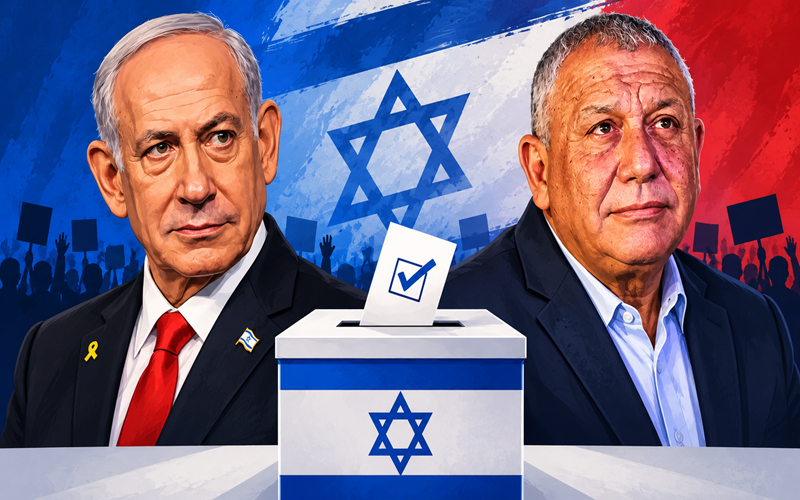
Israeli Prime Minister Benjamin Netanyahu's political alliance has emerged ahead of its main rival in preliminary parliamentary election results, but neither side has secured enough seats to form a government, setting the stage for potentially prolonged coalition negotiations.
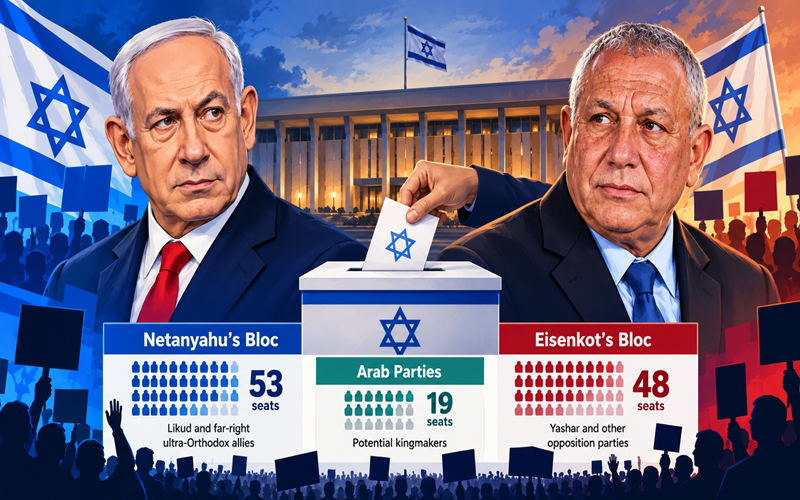
With approximately 85% of ballots counted following Tuesday's general election, Netanyahu's Likud party and its far-right and ultra-Orthodox allies were projected to secure 53 seats in the 120-member Knesset.
The opposition alliance led by former military chief Gadi Eisenkot was expected to win 48 seats, while two Arab-led parties were heading towards a historic combined total of 19 seats.
The projections leave Netanyahu's bloc eight seats short of the 61 required for a parliamentary majority, while Eisenkot's alliance would need another 13 seats to govern independently.
The results have created a complicated political situation in which smaller parties, particularly those representing Arab citizens of Israel, could influence the formation of the next government.
Arab Parties Emerge as Potential Kingmakers
One of the most significant developments in the election has been the strong performance of the Arab-led Joint List and United Arab List.
Together, the parties were projected to secure 19 parliamentary seats, an unprecedented level of representation.
The outcome reflects increased electoral participation among Arab citizens, who constitute approximately one-fifth of Israel's population.
Their parliamentary strength could become decisive if the main opposition parties seek to form a government capable of replacing Netanyahu.
However, potential cooperation remains politically contentious.
Most of the major Jewish-led political parties have previously ruled out forming governing arrangements with Arab factions, although some opposition figures have expressed support for reconsidering that position.
Yair Golan, leader of the left-wing Democrats party, has urged opposition partners to explore cooperation with Arab representatives as a means of establishing an alternative administration.
Joint List chairman Yousef Jabareen has also indicated his party's willingness to support efforts to replace Netanyahu.
United Arab List leader Mansour Abbas, who previously participated in a governing coalition formed after the 2021 election, has expressed hope that cooperation between the opposition and Arab parties could produce a parliamentary majority.
Nevertheless, ideological differences and existing political commitments could make such an arrangement difficult to negotiate.
Netanyahu Calls for Right-Wing Government
Despite falling short of an outright majority, Netanyahu has maintained that his political alliance should lead the next administration.
Addressing supporters at Likud headquarters in Jerusalem, the prime minister called for the establishment of a strong right-wing government.
He also reiterated his opposition to forming an administration dependent on Arab parties that he considers opposed to Israel's Zionist political identity.
Netanyahu's alliance includes far-right and ultra-Orthodox Jewish parties that have supported his government through a period of military conflict and domestic political controversy.
Although his bloc currently holds more projected seats than Eisenkot's alliance, its path to securing additional parliamentary support remains uncertain.
The prime minister's political future will depend partly on whether other factions are prepared to negotiate with Likud and its existing partners.
Eisenkot Says Voters Want Political Change
Eisenkot, leader of the newly established Yashar party, has also declared his intention to form a government.
Speaking to supporters in Tel Aviv, the former military chief argued that the election reflected public dissatisfaction with Netanyahu's leadership.
He pledged to work with other opposition parties to translate electoral support into a change of government.
His alliance includes politicians from different ideological backgrounds, united primarily by their opposition to Netanyahu's continued leadership.
However, differences over security policy, relations with Arab parties and the composition of a future government could complicate coalition discussions.
The opposition initially appeared to have a narrow advantage when Israeli television broadcasters released exit polls shortly after voting ended.
Early projections suggested Eisenkot's political bloc could win between 52 and 53 seats, compared with approximately 50 for Netanyahu's alliance.
Subsequent revisions narrowed that advantage before the official count placed Netanyahu's bloc ahead.
The changing projections have highlighted the uncertainty surrounding the final distribution of parliamentary seats.
High Turnout Reflects Intense Public Interest
Voter turnout reached 77.7%, the highest recorded in Israel in more than two decades.
President Isaac Herzog welcomed the strong participation, describing it as an encouraging indication of public engagement in the country's democratic process.
The president also urged political leaders to approach coalition negotiations with flexibility and avoid another election.
Israel has experienced repeated political deadlocks in recent years, with coalition disagreements contributing to periods of instability.
Herzog is expected to begin formal consultations with parliamentary factions after the official results are confirmed.
Under Israel's political system, the president assigns the task of forming a government to the lawmaker considered most capable of assembling a parliamentary majority.
That individual must then negotiate support from other parties.
If the initial candidate fails, the process may continue through additional political consultations and attempts to form a coalition.
A prolonged failure to establish a government could eventually result in another national election.
Hundreds of Thousands of Votes Await Counting
Although the preliminary figures provide an indication of the parliamentary balance, the election outcome remains subject to the counting of outstanding ballots.
Between 430,000 and 480,000 special ballots were estimated to remain uncounted, including votes cast by military personnel, diplomats and others unable to vote at their regular polling stations.
These ballots are processed separately under procedures designed to prevent duplicate voting.
Election authorities are expected to complete the remaining count before the final results are formally certified.
The outstanding votes could affect the distribution of seats among parties, particularly in a closely divided parliament.
Until the final count is completed, the projected balance between the competing alliances remains provisional.
Security and Gaza War Shape Political Debate
Tuesday's vote was Israel's first general election since the Hamas-led attacks of October 7, 2023, and the subsequent wars involving Gaza, Lebanon and Iran.
The attacks and their consequences have remained central to public debate throughout the campaign.
Opposition leaders have questioned the government's responsibility for the security failures preceding the October 2023 assault and called for greater accountability.
Netanyahu has defended his government's security record, emphasizing military operations against regional adversaries and Israel's strategic position.
The prolonged conflict in Gaza has also affected Israel's international relationships and generated debate over the country's future security and diplomatic priorities.
The competing parties have presented different approaches to leadership and governance, although significant differences also exist within the opposition itself.
Military Service and Judicial Reforms Remain Divisive
Domestic political disputes have further complicated the electoral landscape.
Among the most contentious issues is the conscription of ultra-Orthodox Jewish men, particularly those engaged in full-time religious studies.
The question has generated tension between religious political parties and other sections of Israeli society, especially during a period of extended military operations.
Netanyahu's ultra-Orthodox allies have opposed measures that would substantially expand compulsory service within their communities.
Proposed judicial reforms have also remained a major source of disagreement.
Critics of the government's proposals argue that they could weaken judicial independence and reduce institutional oversight.
Supporters contend that changes are needed to rebalance authority between the judiciary and elected representatives.
The competing positions have contributed to broader disagreements over Israel's political direction.
Coalition Negotiations Could Take Weeks
The election results have left Israel facing an uncertain political future despite the high level of voter participation.
Netanyahu's alliance currently leads the count, but its projected parliamentary strength is insufficient to guarantee another term in office.
Eisenkot's opposition bloc faces an equally challenging task in assembling a viable majority.
The strong performance of Arab parties has introduced another important factor into the political calculations, although cooperation with them remains disputed among potential coalition partners.
President Herzog's consultations are expected to provide the next indication of which political leader has the strongest prospect of forming a government.
Until then, both Netanyahu and Eisenkot are likely to continue seeking support from parliamentary factions.
The election has produced a clearer picture of the country's political divisions than of its next government, leaving Israel potentially facing weeks of negotiations before its future leadership is determined.