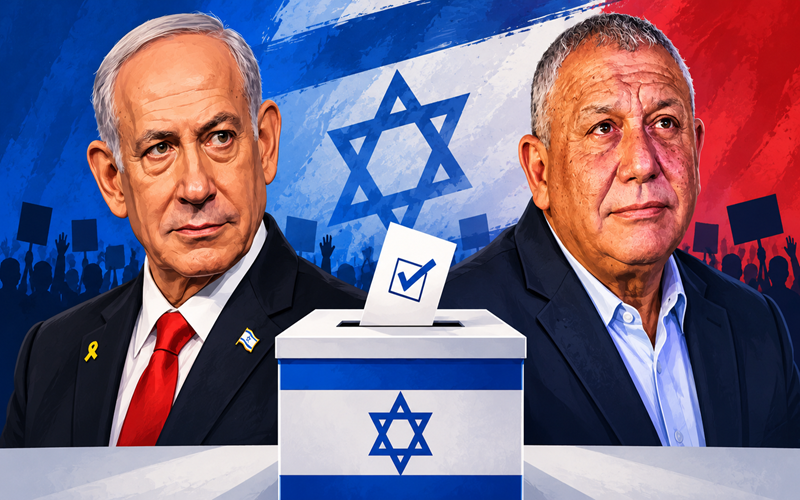
Global Desk, October 29: Israel's domestic intelligence agency, Shin Bet, has launched an investigation into suspected foreign interference in the country's parliamentary election amid allegations of funding and attempts to influence voting.
The probe comes as Prime Minister Benjamin Netanyahu's coalition remains eight seats short of a parliamentary majority, leaving the country's political future uncertain.
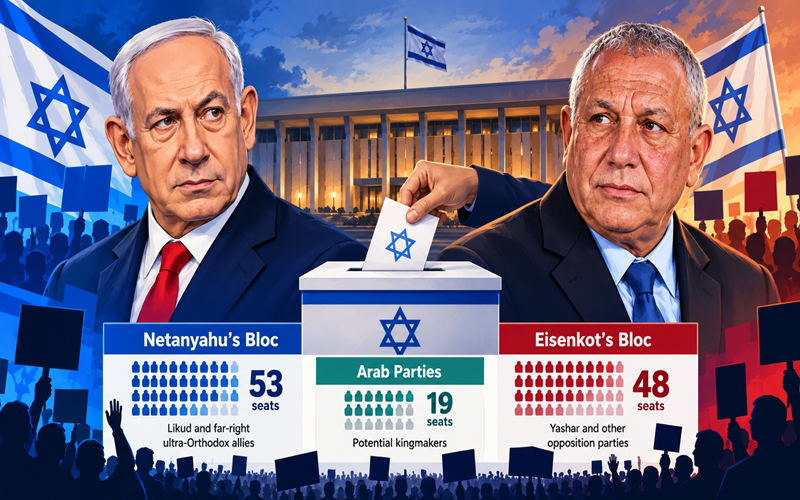
With more than 97 percent of votes counted, Netanyahu's right-wing and religious alliance was projected to secure 53 seats in the 120-member Knesset, while opposition parties held 48 seats and Arab parties were expected to win a combined 19 seats.
The investigation focuses on allegations of improper foreign influence, including suspected involvement by Qatar and Turkey. However, no conclusive evidence establishing that foreign interference affected the election outcome has been publicly confirmed.
Israel's Central Elections Committee has indicated that the investigation will not delay the announcement of final election results or prevent the process of forming a new government.
Shin Bet Investigates Allegations of Foreign Influence
The investigation was initiated following instructions from Central Elections Committee Chairman and Supreme Court Justice Noam Sohlberg amid concerns about possible external attempts to influence the October 27 election.
Shin Bet chief David Zini is expected to brief political party leaders on the investigation, having already informed several senior politicians about developments.
According to Israeli media reports, the security agency initially conducted its inquiries discreetly before expanding the investigation after obtaining intelligence considered sufficiently substantial to justify further examination.
Investigators are reportedly examining allegations of foreign financial involvement and possible attempts to influence voting behaviour.
The inquiry is being coordinated with the Central Elections Committee, which oversees the integrity of Israel's electoral process.
Despite the seriousness of the allegations, a senior election official reportedly assessed that even if the suspected activities were substantiated, their scale was unlikely to have been sufficient to alter the overall election results.
Qatar Rejects Allegations of Election Meddling
Qatar has strongly denied allegations that it financed or participated in attempts to influence Israel's parliamentary election.
Foreign Ministry spokesperson Majed al-Ansari dismissed the accusations, arguing that Israeli political figures and media organisations were spreading misleading claims about Doha.
The allegations have nevertheless intensified political tensions in Israel, particularly over the performance of Arab political parties, which are projected to secure an unprecedented combined 19 parliamentary seats.
There has been no publicly established finding that Qatar or Turkey successfully manipulated the election results.
Netanyahu's Bloc Remains Eight Seats Short of Majority
Revised election projections released Thursday showed Netanyahu's Likud party gaining an additional parliamentary seat, increasing its expected representation to 27.
The gain came at the expense of the ultra-Orthodox Shas party, whose projected representation fell to six seats.
The adjustment did not change the overall parliamentary balance, with Netanyahu's alliance remaining at 53 seats.
Opposition parties were projected to hold 48 seats, while Arab parties maintained their combined 19-seat projection.
A government requires the support of at least 61 lawmakers to command a majority in the Knesset.
The results therefore leave neither Netanyahu's alliance nor the principal opposition bloc with sufficient seats to govern independently.
The distribution of seats has created uncertainty over possible coalition arrangements, with smaller parties potentially holding significant influence over negotiations.
Ben-Gvir Demands Arrests Over Alleged Foreign Funding
Israeli National Security Minister Itamar Ben-Gvir has called for the arrest of Arab political party leaders suspected of involvement in alleged foreign-funded election activities.
Ben-Gvir, who leads the far-right Otzma Yehudit party, urged Shin Bet to investigate individuals allegedly connected to Qatari financing, including suspected intermediaries and organisations.
He said arrests should be pursued where sufficient legal grounds exist.
His demands have added to tensions surrounding the investigation, although allegations of foreign financial involvement have not been established as criminal wrongdoing by the Arab party leaders.
Separately, Israeli police have rejected claims from Netanyahu's Likud party that Arab political parties stole the election.
The competing allegations and denials have heightened concerns about political polarisation as the country awaits the official results.
Liberman Rejects Coalition With Netanyahu and Arab Parties
Avigdor Liberman, leader of the Yisrael Beytenu party, has ruled out joining a government led by Netanyahu or one dependent on Arab political parties.
His position complicates efforts by opposition leaders to assemble an alternative governing coalition.
Liberman indicated that his party would consider participating only in a coalition consisting exclusively of Zionist parties, potentially including Likud if Netanyahu were no longer its leader.
He also rejected cooperation with several ultra-Orthodox political figures.
The position could limit the opposition's ability to secure the 61 seats required to form a government, even if it reaches agreements with other parties.
Ultra-Orthodox Party Reportedly Considers Cooperation With Eisenkot
In a potentially significant development, figures within United Torah Judaism have reportedly expressed interest in exploring cooperation with opposition leader Gadi Eisenkot.
According to Israel's Channel 13, several party representatives indicated they were willing to discuss possible political arrangements despite substantial ideological differences.
The reported openness reflects deep distrust of Netanyahu among some members of the ultra-Orthodox party.
However, no formal negotiations or coalition agreement have been announced, and Eisenkot had reportedly not contacted the party figures at the time of the report.
Any potential arrangement would face considerable challenges because of differences over religious policy, military service and the role of ultra-Orthodox institutions.
Nevertheless, the possibility of cooperation illustrates how the inconclusive election outcome could produce unexpected political alliances.
Opposition Leaders Coordinate Post-Election Strategy
Former prime minister Yair Lapid and Democrats Party chairman Yair Golan held talks Thursday to discuss political coordination following the election.
The meeting was aimed at identifying possible paths towards forming an alternative government.
Golan subsequently indicated that he intended to work closely with other opposition leaders to pursue political change.
However, disagreements among opposition parties over cooperation with Arab lawmakers and religious parties remain major obstacles.
The fragmented parliamentary landscape could make coalition negotiations particularly difficult.
Election Results to Be Finalised Despite Security Investigation
A Central Elections Committee source told The Jerusalem Post that the Shin Bet investigation would not interrupt the publication of the official results.
The source also indicated that President Isaac Herzog would remain free to begin the constitutional process of selecting a political leader to attempt to form a government.
Questions about whether the allegations could justify a new election were described as premature.
Under Israel's electoral framework, challenges to election results would require a legal assessment of whether proven irregularities materially affected the voting outcome or the allocation of parliamentary seats.
Political and legal observers reportedly consider the possibility of invalidating the entire national election highly unlikely based on the information currently available.
Coalition Uncertainty Deepens as Israel Awaits Final Results
Israel now faces two parallel political developments: an intelligence investigation into suspected foreign influence and negotiations over the formation of a government in a deeply divided parliament.
The investigation could become politically significant if authorities uncover credible evidence of unlawful funding or interference.
However, the available information does not establish that the alleged activities changed the election outcome.
Meanwhile, Netanyahu's failure to secure a parliamentary majority has opened the door to negotiations involving opposition parties, Arab lawmakers and ultra-Orthodox factions.
The final election results and subsequent coalition discussions will determine whether Netanyahu can remain in power, whether Eisenkot or another opposition figure can assemble a governing majority, or whether the political deadlock will continue.
For now, the central questions are whether investigators can substantiate the foreign interference allegations and whether Israel's divided political parties can agree on a workable governing coalition.