
U.S. Isolated as Allies Allow Iran to Secure Key United Nations Seat
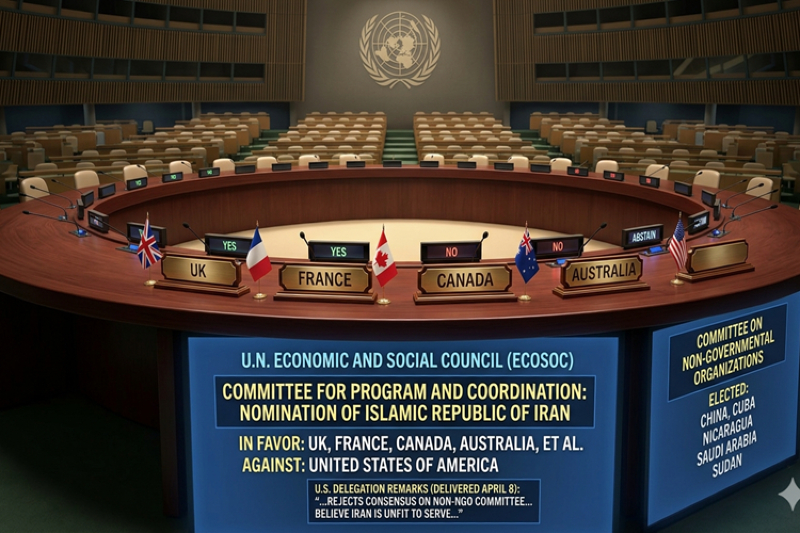
NEW YORK — A significant diplomatic rift has emerged at the United Nations after the United States stood alone in opposing a move to grant the Islamic Republic of Iran a seat on an influential oversight body.
Despite the Biden-Trump transition era's "maximum pressure" rhetoric, key Western allies—including the United Kingdom, France, Canada, and Australia—refused to block the appointment.
The controversy centers on the U.N. Economic and Social Council (ECOSOC), which recently nominated Iran to the Committee for Program and Coordination. This specific body wields considerable power in shaping the U.N.’s global agenda on sensitive issues such as human rights, disarmament, counterterrorism, and women’s rights.
A Break in Consensus
The United States was the sole member of the 54-nation council to formally "disassociate from consensus," a diplomatic maneuver used to signal total opposition. U.S. Ambassador Dan Negrea delivered a sharp rebuke during the session, asserting that the Iranian regime is "unfit to serve" given its history of domestic human rights abuses and regional aggression.
"The regime has, for decades, infringed on the Iranian people’s ability to exercise their basic human rights," Negrea stated, emphasizing that Washington could not support the inclusion of a government that actively threatens international stability.
The "Authoritarian" Committee
Iran was not the only controversial appointment. ECOSOC also confirmed the election of China, Cuba, Nicaragua, Saudi Arabia, and Sudan to the Committee on Non-Governmental Organizations (NGOs). This committee is particularly sensitive because it controls which civil society groups are granted accreditation to operate and speak within the U.S. system.
Human rights advocates warn that packing this committee with authoritarian regimes could lead to a "blacklisting" of pro-democracy groups and organizations that investigate state-sponsored abuses.
Growing Diplomatic Friction
The decision by the UK, France, and other traditional U.S. partners to allow these nominations to proceed highlights a deepening divide over how to manage Tehran.
While the U.S. continues to push for total diplomatic and economic isolation, its allies appear more inclined to maintain functional participation within international institutions, even as they face public backlash for doing so.
Because the U.N. General Assembly typically approves ECOSOC recommendations without a formal vote, Iran’s position on the committee is considered a near-certainty.
The move comes at a particularly volatile time, as the U.S. enforces a naval blockade in the Persian Gulf and struggles to find common ground with its European counterparts on the future of Iranian diplomacy.