
The Budapest Earthquake: Péter Magyar Topples Orbán’s ‘Illiberal’ Fortress After 16 Years
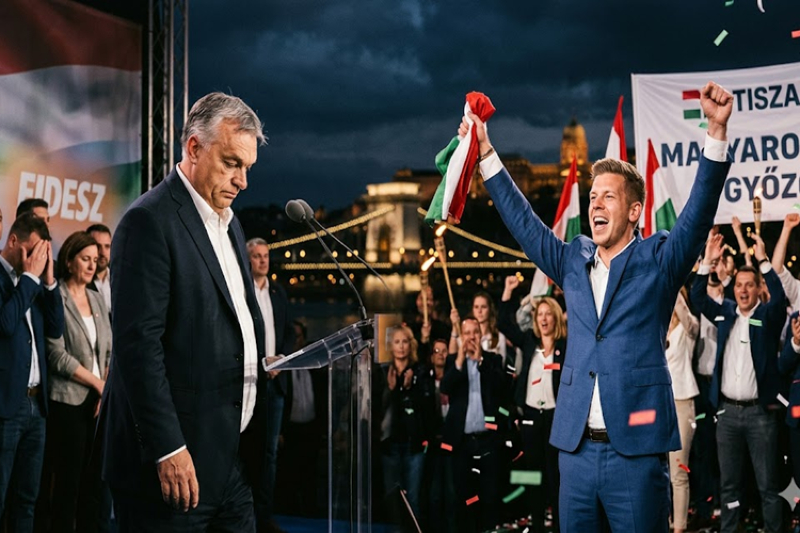
BUDAPEST — In a political earthquake that has reshaped Central Europe, Viktor Orbán has officially conceded defeat, marking the end of his nearly two-decade-long hold on Hungary.
The opposition, led by the meteoric rise of Péter Magyar and his Tisza party, is currently on track for a historic landslide victory.
With over 80% of the ballots processed, the results suggest a total shift in the Hungarian landscape. Magyar, a former government insider turned relentless critic, appears poised to secure a two-thirds "constitutional majority" in Parliament—the very tool Orbán once used to reshape the nation’s laws.
The Rise of a New Leader
Standing before a massive, torch-lit crowd in the capital, an emotional Péter Magyar declared that the country had been "liberated" from the Orbán regime. "Together, we did it," he told cheering supporters, waving the Hungarian flag.
Magyar’s campaign successfully bridged the gap between traditional opposition voters and disillusioned former supporters of the ruling Fidesz party. His platform focuses on:
Anti-Corruption: Dismantling the network of political cronyism.
EU Integration: Restoring strained relationships with Brussels.
Social Reform: Fixing chronic issues in Hungary’s healthcare and education systems.
A Shift in Geopolitics
The repercussions of this election extend far beyond Budapest. Orbán’s exit removes a significant obstacle within the European Union and NATO, where he frequently clashed with allies over aid to Ukraine and democratic standards.
World leaders were quick to react:
European Commission President Ursula von der Leyen celebrated the news, stating that "Europe’s heart is beating stronger in Hungary tonight."
German Chancellor Friedrich Merz expressed his eagerness to work with the new administration toward a "united Europe."
UK Prime Minister Keir Starmer called the win a "historic moment for European democracy."
Orbán’s Concession
A somber Viktor Orbán addressed his followers after calling Magyar to congratulate him. Acknowledging that the results were "clear and painful," he urged his supporters to remain resilient. "We never give up," Orbán said, promising to rebuild his political community from the opposition benches.
What Happens Next?
As the final votes from abroad and distant districts are tallied, the focus turns to whether the Tisza party will maintain its 137-seat projection. If they hold that supermajority, Magyar will have the legal power to immediately begin reversing Orbán’s constitutional changes.
For a country that has known only one leader since 2010, the "two worlds" of Hungarian politics have finally collided, signaling a new chapter focused on transparency and European alignment.
Why Orbán’s Exit Reshapes the West
Viktor Orbán’s defeat is a massive geopolitical event because he wasn't just a local leader; he was the primary "disrupter" within the Western alliance. His exit shifts the balance of power across three major fronts:
1. The End of the "EU Veto" Era
For years, Orbán used Hungary’s veto power within the European Union to block or delay critical decisions.
Ukraine Support: He frequently blocked billions in aid to Kyiv and sanctions against Moscow.
With Péter Magyar—who is much more pro-European—in power, the EU can finally act with a unified voice. Frozen Funds: Brussels had frozen roughly €20 billion in funds for Hungary due to corruption concerns.
Magyar’s victory likely unlocks this money, reintegrating Hungary into the European economy.
2. A Blow to the "Populist Axis" (Putin & Trump)
Orbán was the bridge between European populism, the Kremlin, and the American "MAGA" movement.
Vladimir Putin: Orbán was Russia's closest ally inside the EU and NATO.
His departure leaves Putin without a high-level advocate to soften Western policy from the inside. Donald Trump: Orbán was a key ideological ally for Trump.
Just last week, U.S. Vice President JD Vance campaigned for Orbán in Budapest. His loss signals a potential decline in the momentum of the global far-right movement.
3. Stability for NATO
Hungary often delayed the expansion and strategic movements of NATO (most notably during Sweden and Finland’s accession). A government under Magyar is expected to be a more "predictable" partner, strengthening NATO’s eastern flank at a time when tensions with Russia and the ongoing crisis in the Middle East (like the Strait of Hormuz blockade) require Western unity.
Summary of the Shift
| Policy Area | Under Orbán | Expected Under Magyar |
|---|---|---|
| EU Relations | Constant conflict / "Huxit" rhetoric | Closer cooperation / Rejoining the fold |
| Ukraine War | Skeptical / Blocks military aid | Generally supportive (though cautious) |
| Russia | Energy dependence & friendly ties | Gradual distancing from Moscow |
| Democracy | "Illiberal democracy" / State control | Restoration of the rule of law |
The Bottom Line: For the first time in 16 years, the "roadblock" at the center of Europe has been removed. This allows the EU and NATO to function more efficiently without one country constantly pulling in the opposite direction.