

Stunning “Smiling” Fossil Found on Holy Island Sparks Global Buzz
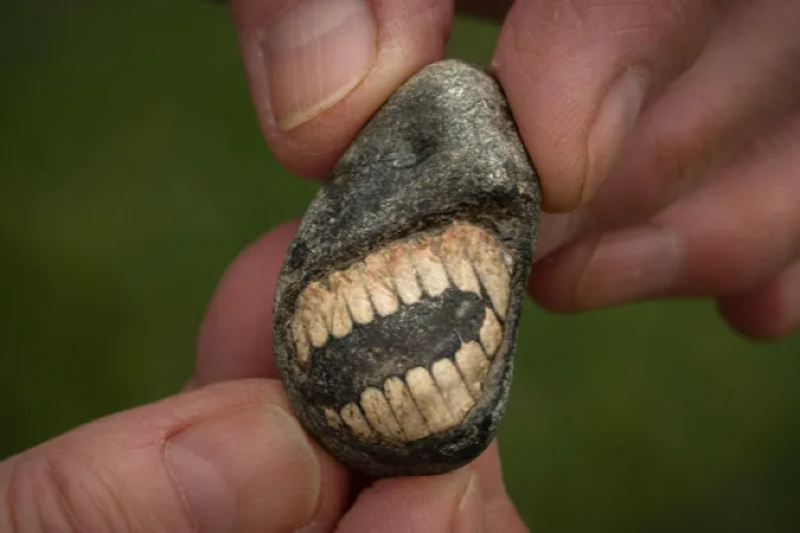
A remarkable fossil resembling a grinning face has been uncovered on Holy Island (Lindisfarne) off the coast of Northumberland, England, exciting archaeologists and fossil hunters around the world.
How It Was Found:
The fossil was spotted by Christine Clark, 64, while walking the beach during a Boxing Day holiday.
She noticed a small pebble that looked like it had “fake teeth” or a smile, and shared the image in an online fossil group, which quickly drew widespread attention.
What the Fossil Is:
Experts from the British Geological Survey (BGS) confirmed the object is a rare piece of a crinoid stem — an ancient marine animal that lived about 350 million years ago.
Crinoids, sometimes called “sea lilies,” are distant relatives of sea urchins and sea cucumbers.
This particular stem section split lengthwise and curved in a way that gives the appearance of a mouth or smile — a striking visual that has captured public imagination.
Scientific and Cultural Significance:
Holy Island is famous for its fossil-rich shores, especially crinoid stem discs known as “St Cuthbert’s beads,” historically collected and worn as necklaces.
Dr Jan Hennissen, senior paleontologist at BGS, explained that complete or unusual crinoid pieces are rare, making this find especially intriguing for paleontologists studying ancient marine ecosystems.
The discovery not only fascinates with its “smiling” look but also highlights how everyday coastal walks can lead to scientifically valuable finds.
Public Reaction and Next Steps:
Photos of the fossil have garnered thousands of likes and comments online, blending science with playful curiosity.
While Clark has received offers to buy it, she plans to keep the fossil, noting the joy and amusement it has brought.
Experts invite the public to share fossil photos with identification services, helping build understanding of ancient life.