

Part 5: Contempt of Court – The Shaking of the Pillars
Mankin Devil entered the Supreme Court premises early in the morning.
The court complex breathed in its own solemn rhythm. Tall buildings stood like silent witnesses, old trees whispered through moving air, and people walked with measured dignity, as if every step inside the sacred precinct carried historical weight.
Mankin observed them all.
He remembered the doctrine of a free press—the belief that journalism was the fourth pillar standing beside the executive, the legislature, and the judiciary, watching, questioning, and sometimes unsettling power when it grew too comfortable.
He walked slowly, deliberately, studying the posture of lawyers and court staff, as though body language itself was part of legal philosophy. Were their shoulders too rigid? Were their steps too hurried? He wondered silently whether modern professionalism had forgotten natural human rhythm.
At the court canteen, he took breakfast with careful curiosity.
While eating, he asked about the ownership of the canteen, the quality of the food, and whether the establishment possessed proper certification from the relevant food and drug authorities. His questions were not merely practical; they were philosophical, almost investigative, as if every institution inside the court complex should answer to the logic of regulation.
He even spoke to a lady lawyer with unexpected frankness.
“Do you feel safe from harassment within the court premises?” he asked her quietly.
The question surprised her.
Inside Mankin’s mind, journalism was never only about reporting events. It was about interrogating social space itself.
During the hearing, Justice Tom Gillan Hegel asked Mankin to produce documents proving ownership.
Mankin requested seven days’ adjournment to collect the necessary papers.
Ten days later, he returned.
But his lawyer, Richard Clerk, declined to continue representation, explaining that the permitted time frame had already passed.
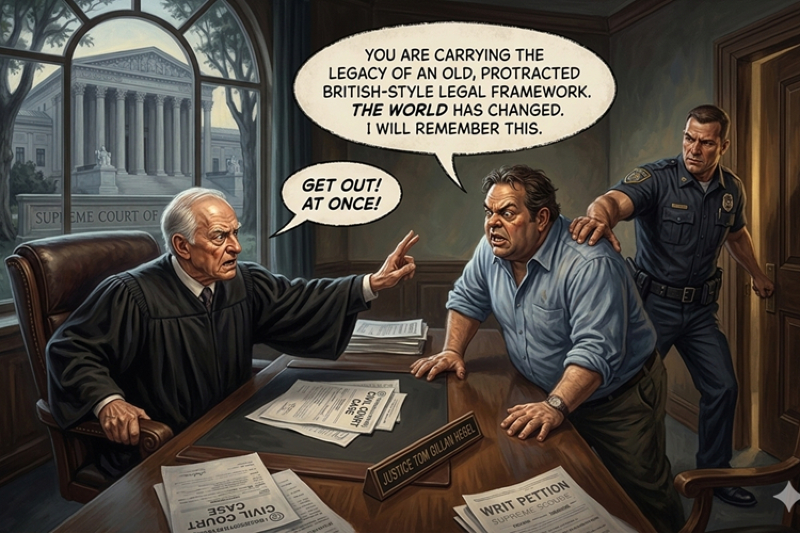
At lunchtime, Mankin entered the judge’s personal chamber.
The judge looked up sharply.
“Why did you enter here?” he asked with restrained anger.
Mankin placed his words carefully, like chess pieces.
“I needed ten days to collect the documents,” he said. “I was late by three days due to the hassle of gathering the required papers.”
The judge replied that a court’s order could not be ignored and that there was no legal scope to miss a deadline.
Mankin continued, “My lawyer had told me that a two or three day delay was not unusual and would not cause any serious procedural problem. I relied partly on that advice. However, today my lawyer refused to take responsibility and declined to proceed further. Finding no other path, I entered your chamber.”
Then, with unusual boldness, he added, “Perhaps we may speak as individuals of similar intellectual lineage. You studied law. I studied journalism.”
The judge asked about his academic session.
Mankin promised that he would submit the documents later—ownership papers and academic certificates alike—if the court granted him further opportunity.
As he spoke, he attempted something strangely theatrical.
He moved closer, repeating softly, almost stubbornly, “We are colleagues now. Not adversaries.”
The gesture unsettled the judge.
Mankin’s voice carried a subtle undertone of intimidation disguised as social familiarity.
“I have been invited to cover international conflicts as a journalist,” he said, almost as a warning.
The judge understood the intention behind the words.
Then the judge spoke.
“Get out.”
The voice was sharp, final.
“Get out at once.”
Hansen stood motionless for a moment.
Then he responded with philosophical defiance.
“You are still carrying the legacy of an old, protracted British-style legal framework,” he said. “The world has changed. You must speak and act in the spirit of the twenty-first century. Society is no longer frozen inside inherited stereotypes.”
The judge’s bodyguard escorted him toward the door.
While leaving, Mankin spoke in a low, deliberate tone.
“I am a journalist,” he said. “I have access to the head of state, to the commanders of the three services, and to the machinery of the nation. I will remember this, Your Honour.”
He did not shout.
Threat was not always loud.
Sometimes it was quiet certainty.
Over the next three days, Mankin published a series of reports criticizing the conduct of the judge and the broader legal culture. His writings questioned courtroom decorum, the position of clients during hearings, and the symbolic hierarchy where officials and senior journalists often stood while judges sat in authority.
The articles carried his signature style—argumentative, provocative, and philosophically whimsical—blending criticism of institutional tradition with reflections on modern governance.
Some readers agreed.
Some dismissed him as theatrical.
But Mankin did not seek universal approval.
He sought intellectual confrontation.
The court, the newsroom, and the public sphere had become arenas of a larger battle—between authority and interpretation, between tradition and modernity, and between control and defiance.
And somewhere beneath it all, the story still waited for its final turn.
▶ Read part 6 https://thereporter24.com/news/part-6-the-river-and-the-future