
Munich Security Conference 2026: A Geopolitical Reckoning for Europe
Feb 14, 2026: The 62nd Munich Security Conference (MSC), held February 13–15, 2026, has emerged as more than just a gathering of global leaders.
While on the surface it presented discussions on Ukraine, Arctic security, and China’s rising influence, the undercurrents of transatlantic tension and power recalibration have made this year’s summit a pivotal moment in European and global security.
A Fractured Transatlantic Alliance
Europe’s relationship with the United States is undergoing a profound transformation. The Trump administration’s recent actions—including repeated threats to annex Greenland, unpredictable tariffs, and unilateral diplomacy with Russia—have left many European leaders questioning US reliability.
German Chancellor Friedrich Merz warned, “Even the US will not be powerful enough to go alone,” signaling a call for Europe to develop its own strategic autonomy. French President Emmanuel Macron echoed the need for an independent European security framework while simultaneously affirming continued cooperation with NATO allies.
Starmer and Europe’s Balancing Act
UK Prime Minister Keir Starmer emphasized a pragmatic approach: maintaining defense cooperation with Europe without reversing Brexit. His speeches and meetings in Munich underscore Britain’s desire to retain a leadership role in European security, particularly in Ukraine, while navigating a delicate relationship with the US.
Starmer’s presence, alongside European Commission President Ursula von der Leyen, signals Britain’s intention to remain a decisive security actor in Europe, even as the continent recalibrates under growing geopolitical uncertainty.
The Shadow of Trump and the US Approach
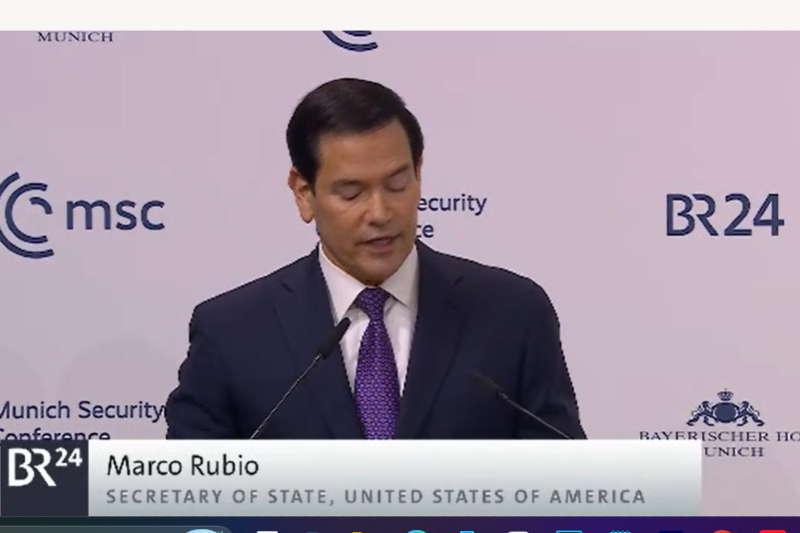
The conference highlighted the unpredictability of the Trump administration. US Secretary of State Marco Rubio spoke of a “new era in geopolitics,” reflecting a broader perception among European leaders that Washington is increasingly focused on self-interest rather than shared democratic values.
While Europe had relied on US backing for decades, the message from Munich was clear: Europe must now prepare to act independently while still managing a complex alliance with Washington.
Unfinished Business: Ukraine, Russia, and Sanctions
Ukraine remains at the heart of European strategic thinking. President Volodymyr Zelenskyy stressed that no peace deal with Russia could succeed without strong security guarantees, reconstruction assistance, and continued pressure on Moscow. Zelenskyy also warned that any compromise without enforceable protections could be exploited by Russia, reflecting growing European and Ukrainian skepticism toward unilateral US diplomacy.
Arctic and Greenland: The Cold Front of Geopolitics
The Arctic, particularly Greenland, has become a flashpoint for European-US relations. Trump’s earlier insistence on “owning” Greenland has left lingering anxieties. Meetings between Danish Prime Minister Mette Frederiksen, Greenland’s Jens-Frederik Nielsen, and US officials highlighted ongoing negotiations, but European leaders are wary of any US unilateral moves in the region.
This dispute is symbolic of a larger European realization: reliance on US security may no longer guarantee strategic stability.
Strategic Autonomy and Nuclear Ambitions
Europe is contemplating a new defense posture. French President Macron, together with Germany’s Merz, is exploring a European nuclear umbrella and long-range missile programs. This represents a shift from reliance on NATO and the US to an independent European deterrent capability.
Macron also stressed that Europe must reorganize its security architecture to confront modern threats—ranging from Russia to cyberattacks and AI-enabled disinformation campaigns—highlighting a long-term vision for strategic autonomy.
The Global South and Multipolar Realities
The MSC also revealed a divergence between Europe and emerging powers in the Global South. Countries like India and Brazil are approaching the shift in global power not with anxiety, but with pragmatism, seeing multipolarity as an opportunity to assert influence in a post-US-centric order. This adds complexity to Europe’s efforts to unify allies under a single strategic framework.
Conclusion: Europe’s Moment of Reckoning
The 2026 Munich Security Conference has demonstrated that Europe stands at a crossroads. With an unpredictable US, a resurgent Russia, and an evolving multipolar world, European leaders are under pressure to assert autonomy, strengthen internal defense mechanisms, and safeguard their strategic interests.
While alliances have not disintegrated, the conference underscored that the era of unquestioned reliance on the US is over. Europe must now prepare for a world where it cannot take American support for granted—a reality that will shape transatlantic politics for decades to come.