

Historic Return: Artemis II Crew Back on Earth After Record-Breaking Moon Mission
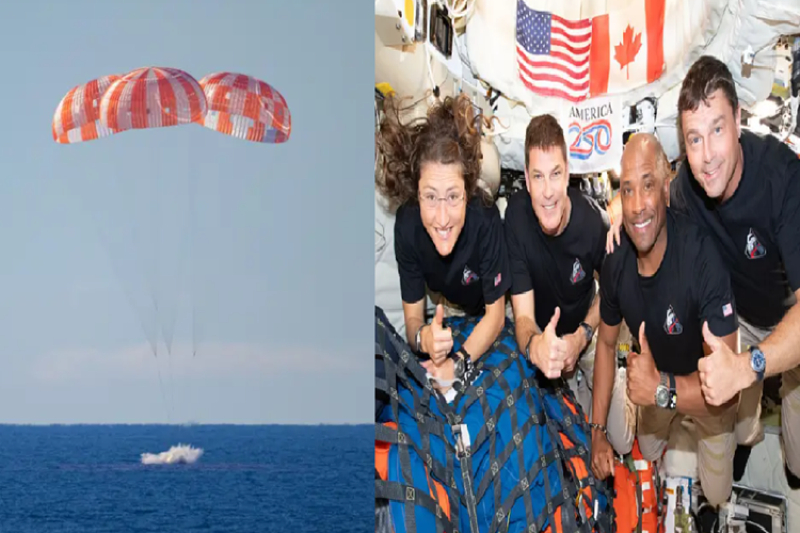
PACIFIC OCEAN – A new chapter in human spaceflight began today as the four astronauts of the Artemis II mission safely splashed down in the Pacific Ocean, marking the successful conclusion of a historic 10-day journey around the Moon.
The Orion spacecraft touched down at 00:07 GMT, following a precise re-entry that included a tense six-minute communications blackout. NASA officials confirmed shortly after that Commander Reid Wiseman, Victor Glover, Christina Koch, and Jeremy Hansen are all "happy and healthy."
Breaking Records and Barriers
The mission was a resounding success, pushing the boundaries of how far humans can travel into the cosmos. On April 6, the crew reached a maximum distance of 406,771 km (252,756 miles) from Earth during their lunar flyby. This milestone officially broke the record for the furthest distance humans have ever traveled into space, surpassing the mark set during the Apollo era.
During their time behind the Moon, the crew witnessed a rare celestial event: a total solar eclipse from a vantage point never before experienced by humans. "It was a totally unique experience," said Lori Glaze, NASA's acting associate administrator. "We have gathered an immense amount of data that will be analyzed in the coming weeks."
The Road Ahead
The success of Artemis II serves as a vital "inflection point" for NASA. The mission was designed to test the Orion spacecraft’s life-support systems with a crew on board, proving that long-duration lunar travel is once again possible.
"Today marks the start of a new era of human space exploration," stated Howard Hu, NASA Orion Program Manager. "That little kid who was inspired by the stars... now we are able to send our crew out to the stars, the farthest any humans have been."
Key Mission Statistics:
Total Distance Traveled: 700,237 miles
Peak Velocity: 24,664 mph
Mission Duration: 10 Days
A Global Celebration
The return was met with jubilation at watch parties across the globe. For the families of the astronauts, the moment was deeply personal. Ashley Hansen, daughter of Canadian astronaut Jeremy Hansen, shared the family’s long-standing tradition of saying "I love you to the moon and back," a phrase that has now taken on a literal meaning.
As the crew is transported to the USS John P. Murtha for further medical evaluations, NASA is already looking toward the future. With the Artemis II data in hand, the agency is preparing for Artemis III, which aims to land the first woman and the first person of color on the lunar surface. Officials suggest the next mission is "right around the corner," potentially as early as next year.
While the program carries a significant price tag—estimated to exceed $93 billion—NASA advocates argue the investment is essential for maintaining a peaceful international presence on the Moon and fueling the "Artemis Generation" of future scientists and explorers.