
Experts Warn U.S. Attacks on Iran May Constitute War Crimes as Trump Targets Power Grid
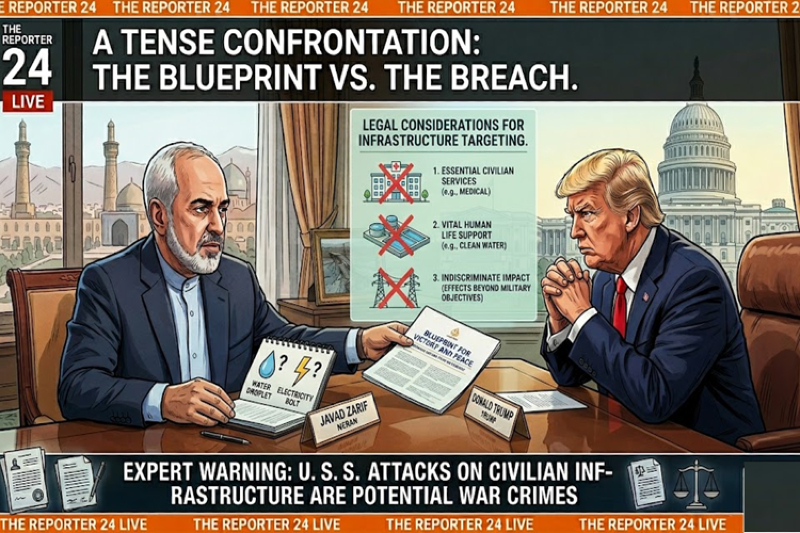
WASHINGTON/TEHRAN — International law experts have issued a stark warning that recent and proposed U.S. military actions against Iran may cross the threshold into war crimes.
This legal outcry comes as President Donald Trump escalates his rhetoric, specifically threatening to dismantle Iran’s civilian power grid and national infrastructure.
Legal Experts Raise "War Crime" Concerns
Over 100 international law professors and experts from elite institutions—including Harvard, Yale, and Stanford—have signed an open letter condemning the current trajectory of "Operation Epic Fury."
The experts argue that targeting infrastructure essential for human survival, such as electric power plants and desalination facilities, violates the Geneva Conventions. Under international humanitarian law, attacks must distinguish between military objectives and civilian objects. Experts contend that:
Desalination Plants: These are primary water sources for millions; their destruction creates a humanitarian catastrophe.
Power Grids: Striking the electrical grid disables hospitals and sanitation systems, leading to "indiscriminate harm" to the civilian population.
The letter concludes that statements from senior U.S. officials regarding the intent to "destroy what's left" of Iran raise "serious concerns about violations of international human rights law."
Trump Targets Bridges and Energy Infrastructure
Despite the legal warnings, President Trump has doubled down on a "maximum destruction" strategy to force a regime change. Following the demolition of the Karaj B1 Bridge by U.S. forces, the President signaled that the campaign is only in its infancy.
"The U.S. military hasn't even started destroying what's left in Iran," Trump posted on social media. "Bridges next, then Electric Power Plants. [Iran's] leadership knows what has to be done, and has to be done, FAST!"
Defense Secretary Pete Hegseth supported this stance, indicating that the U.S. objective is to render the Iranian state incapable of functioning if they do not meet Washington’s terms by the April 6 deadline.
Cyber Warfare and Regional Retaliation
The conflict has expanded into a multi-front digital and kinetic war. The Islamic Revolutionary Guard Corps (IRGC) claimed responsibility for several "retaliatory" strikes targeting Western digital infrastructure:
Dubai & Bahrain: Iranian state media claimed successful cyber-intrusions into an Oracle data center in Dubai and an Amazon cloud facility in Bahrain. While local officials have downplayed the functional impact, the claims underscore the vulnerability of global tech hubs in the region.
Iraq: Two drones reportedly targeted a U.S. diplomatic facility near Baghdad International Airport, maintaining pressure on U.S. personnel outside the immediate conflict zone.
Humanitarian Toll in Israel and Iran
While the U.S. focuses on infrastructure, Iran has continued to utilize cluster munitions in its missile strikes against central Israel. Impacts in Petah Tikva and Mazkeret Batya have left craters near schools and injured several civilians.
Since the conflict erupted on February 28, the casualties have reached a critical point:
Israel: 22 civilians and 9 IDF soldiers killed; over 6,000 injured.
United States: 11 soldiers killed in regional strikes.
Iran: Massive civilian displacement following the death of Ayatollah Ali Khamenei and ongoing aerial bombardments of Tehran.
As the UN Security Council prepares to vote on a resolution to forcibly open the Strait of Hormuz, the international community remains divided on whether the U.S. strategy of targeting civilian infrastructure will lead to a swift surrender or a prolonged humanitarian disaster.