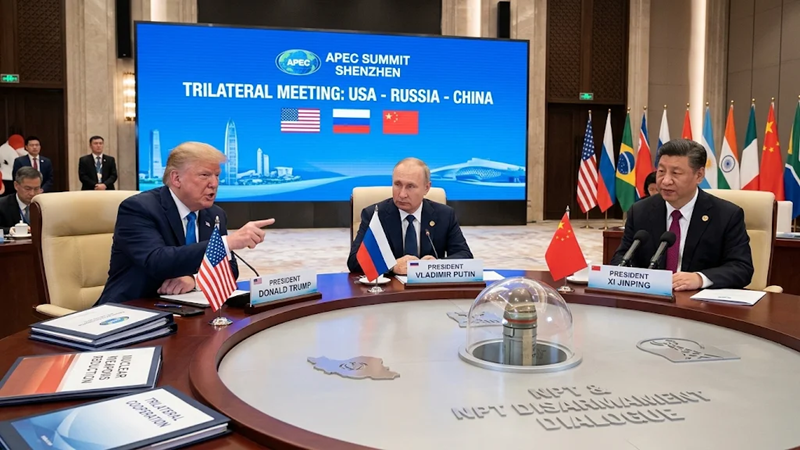
WASHINGTON, D.C., Nov. 14 — U.S. President Donald Trump, Russian President Vladimir Putin, and Chinese President Xi Jinping are set to hold a historic first-ever three-way summit in China late next week, the White House announced.
The unprecedented meeting between the leaders of the world’s three largest nuclear powers will take place on the sidelines of the two-day Asia-Pacific Economic Cooperation (APEC) summit in the southern Chinese tech hub of Shenzhen.
Nuclear Arms and Iran on the Agenda
According to White House spokeswoman Olivia Wales, the trilateral talks will cap off Trump’s visit to China. Before the three-way gathering,
Trump is scheduled to arrive in Shenzhen late Wednesday—following a stop in the Philippines on Tuesday for an Association of Southeast Asian Nations (ASEAN) summit—and will hold bilateral talks with Xi on Thursday, marking their fourth meeting since Trump returned to the White House in 2025.
Nuclear Non-Proliferation: Wales stated that Trump intends to prioritize the global reduction of nuclear weapons, describing proliferation as a severe danger.
The talks come nine months after the final nuclear arms control treaty between Washington and Moscow expired in February, leaving the two superpowers without formal arsenal caps for the first time in over five decades.
Trump has previously pushed to replace the lapsed bilateral pact with a broader framework that includes China’s expanding nuclear stockpile.Iran Included, Ukraine Excluded: A senior U.S. official confirmed that while the ongoing conflict in Iran will likely be raised during the trilateral session, the war in Ukraine is not on the agenda, as Washington is pursuing separate diplomatic tracks with Moscow and Kyiv.
No formal agreements are expected to emerge from the talks.
Shifting Geopolitical Dynamics
While Kremlin spokesman Dmitry Peskov indicated earlier this month that Moscow was ready for such discussions,
Beijing has yet to officially confirm the trilateral meeting—with Chinese state media only reporting on Xi’s scheduled bilateral engagements at APEC.
The summit unfolds amid shifting alliances and heightened Western scrutiny. Earlier this year, Xi hosted both Putin and Trump in Beijing just days apart before visiting Washington in September.
Although U.S.-China engagements have yielded limited breakthroughs on trade, artificial intelligence, and Taiwan, recent moves by Washington—including an agreement to import
Russian diesel and the suspension of certain sanctions on major buyers of Russian energy, such as China—have sparked concern among European allies over a softening U.S. stance toward the Kremlin.