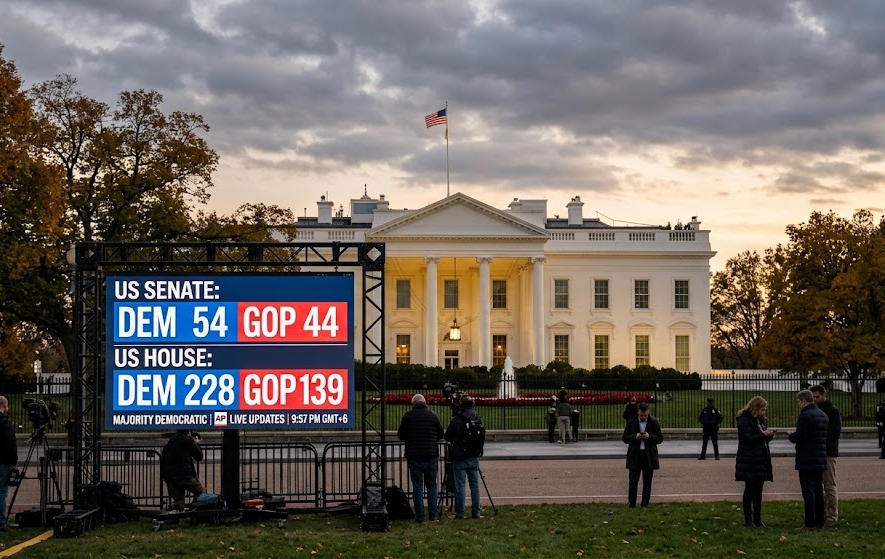
When an opposition party sweeps the U.S. Midterm Elections—capturing majorities in both the House of Representatives and the Senate while an opposing president sits in the White House—it fundamentally alters how the American government operates for the final two years of that president's four-year term.
Understanding this power shift requires examining how the U.S. election and governmental systems function, followed by the specific impacts of an opposition sweep.
🏛️ 1. How the U.S. Election & Government System Works
The United States operates under a presidential system characterized by a strict Separation of Powers and Checks and Balances among three independent branches:
Executive Branch (The President): Head of state, head of government, commander-in-chief of the armed forces, and manager of federal agencies.
Legislative Branch (Congress): Divided into two chambers:
House of Representatives (435 seats): Members serve 2-year terms. Controls federal spending bills ("power of the purse") and initiates impeachments.
Senate (100 seats): Members serve 6-year terms. Approves federal judges, presidential appointments, treaties, and conducts impeachment trials.
Judicial Branch (Supreme Court & Federal Courts): Interprets laws and reviews their constitutionality.
What is a "Midterm Election"?
Midterm elections occur precisely halfway through a president's 4-year term. All 435 House seats and roughly one-third of Senate seats are up for election.
Midterms historically serve as a national referendum on the sitting president's economic performance, foreign policies, and governing style. When voters are unhappy with high inflation, war, or political friction, they frequently punish the president's party by voting for the opposition.
⚡ 2. What Happens When the Opposition Sweeps Congress?
When the opposition party controls both the House and the Senate, the country enters a period of Divided Government. The presidency loses its legislative majority, creating major consequences for governance:
1. Legislative Deadlock & Gridlock
End of the President's Domestic Agenda: The president can no longer easily pass key domestic legislation, sweeping tax overhauls, or signature spending programs.
Compromise or Stagnation: To pass any federal budget or law, the White House must negotiate directly with opposition leaders (e.g., the new Speaker of the House and Senate Majority Leader). If neither side compromises, the government faces potential shutdowns and policy gridlock.
2. The Power of the Veto & Override
Presidential Veto: If Congress passes laws favored by the opposition, the president can veto (reject) them.
Veto Override: Congress can override a presidential veto, but doing so requires a two-thirds majority in both chambers—a high threshold rarely met without broad bipartisan support.
3. Aggressive Oversight & Subpoena Power
Congressional Investigations: With majorities in both chambers, opposition members become chairs of every House and Senate committee. They gain full authority to launch congressional investigations into White House administration practices, spending, and foreign policy decisions.
Subpoenas: Committee chairs can issue legally binding subpoenas to compel executive officials to testify or release internal records, emails, and financial documents.
4. Senate Control over Judicial & Executive Appointments
Blocking Judges & Cabinet Secretaries: The Senate holds the exclusive power to confirm presidential nominees. An opposition-controlled Senate can stall, block, or reject the president's picks for federal courts, Supreme Court vacancies, cabinet positions, and diplomatic posts.
5. Threat of Impeachment
Under the U.S. Constitution, the House of Representatives holds the sole power to impeach a president for "high crimes and misdemeanors". With an opposition majority in the House, the risk of launching formal impeachment inquiries increases significantly.
Note: Removing a president from office still requires a two-thirds vote in the Senate, which is extremely difficult to achieve.
6. Pivot to Foreign Policy & Executive Orders
Facing opposition roadblocks in Congress, presidents whose party loses midterms typically shift their focus to Executive Orders (directives that don't require congressional approval) and Foreign Policy, where executive power is broader.
📌 Summary
In simple terms, a midterm opposition sweep takes away the president's "blank check" to rule. For the final two years of their term, the president switches from an offensive position (passing new laws and setting national policies) to a defensive position (fighting off congressional investigations, defending cabinet nominees, and relying on vetoes).