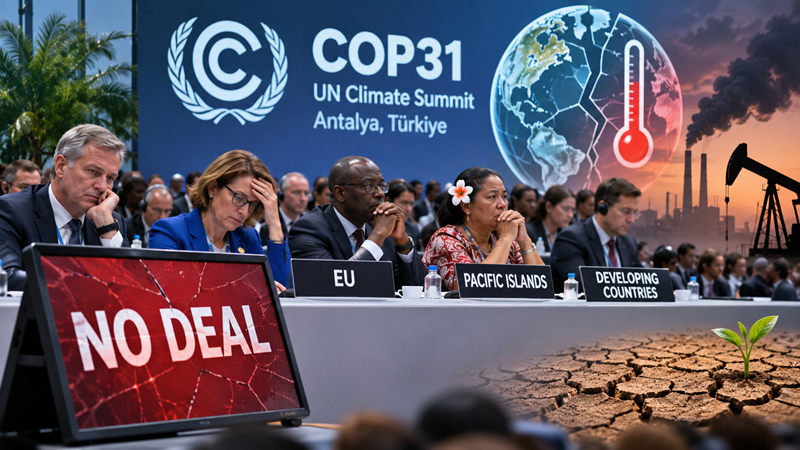
ANTALYA, Turkey, November 23, 2026: The United Nations COP31 climate summit has concluded without a comprehensive political agreement after prolonged negotiations failed to resolve disputes over fossil fuels and financial support for developing countries, dealing a significant setback to international efforts to combat global warming.
The conference, hosted by Turkey with Australia leading the negotiations, extended beyond its scheduled Friday conclusion into Sunday as delegates struggled to reach a consensus.
The prolonged discussions made COP31 the longest-running UN climate conference on record, according to BBC Climate and Science reporting.
However, the additional negotiations failed to bridge differences between countries seeking stronger commitments to reduce dependence on coal, oil and natural gas and those resisting explicit language on fossil fuels.
Financial assistance for poorer countries facing increasingly severe climate impacts emerged as another major source of disagreement.
The breakdown marked the first collapse of a COP summit's principal political agreement since the Copenhagen climate conference in 2009.
Fossil Fuel Dispute Prevents Agreement
One of the most contentious issues was the absence of any direct reference to fossil fuels in the final draft presented to negotiators early on Sunday.
The omission drew strong objections from the European Union, Pacific island nations and several other countries that argued meaningful climate action requires explicit recognition of the role of coal, oil and gas in driving global warming.
The document referred indirectly to the 2023 COP28 agreement, under which countries committed to transitioning away from fossil fuels in energy systems.
However, critics considered that reference insufficient to demonstrate stronger international action.
Irish Minister Darragh O'Brien, representing the European Union, expressed firm opposition to the proposed text, arguing that it lacked the ambition required to confront the climate crisis.
He questioned how a global climate agreement could adequately address rising temperatures without directly identifying fossil fuels.
Countries including Panama and the Marshall Islands also voiced concern that the proposed commitments fell short of the measures needed to protect vulnerable populations from worsening climate impacts.
Their objections ultimately contributed to the failure to secure consensus.
Oil-Producing Nations Resist Stronger Language
The disagreement over fossil fuels reflected longstanding differences between major energy-producing countries and governments seeking a faster transition towards cleaner alternatives.
An earlier draft circulated during the negotiations had included several references to fossil fuels.
Those references were subsequently removed amid objections from oil-producing nations.
Saudi Arabian delegate Mohammad Ayoub defended the position of Arab countries, saying they had participated constructively in the negotiations.
He also argued that their contribution to historical greenhouse gas emissions was relatively limited.
Russia warned against adopting what it considered overly simplistic positions on fossil fuels.
Its representatives maintained that an excessively rapid shift away from conventional energy sources could increase energy costs and create difficulties for vulnerable households.
These arguments contrasted sharply with the position of countries demanding a clearer timetable for reducing fossil fuel dependence.
The differences demonstrated how energy security, economic development and historical responsibility continue to complicate international climate diplomacy.
Developing Countries Demand Clear Climate Finance Commitments
Disagreements over financial assistance created another obstacle to reaching a comprehensive agreement.
Many developing countries sought stronger guarantees that wealthier nations would provide resources to help vulnerable communities adapt to climate change.
Adaptation measures can include flood protection, drought-resistant agriculture, improved water management and infrastructure designed to withstand extreme weather.
At COP30 in Brazil, countries had agreed to triple adaptation finance.
However, the draft agreement considered at COP31 did not establish clear financial figures or specify the baseline against which the earlier commitment would be measured.
Developing countries feared that the absence of measurable targets could allow wealthy governments to interpret their commitments flexibly without delivering sufficient additional resources.
Mohamed Adow, representing the African climate and energy organisation Power Shift Africa, criticised richer countries and major polluters for failing to provide the financial commitments needed to address the crisis.
The dispute highlighted continuing concerns about the unequal burden of climate change.
Many poorer countries contribute relatively little to historical greenhouse gas emissions but face severe consequences from rising temperatures, droughts, floods and other climate-related hazards.
UN Secretary-General Expresses Disappointment
UN Secretary-General António Guterres expressed strong disappointment over the failure to reach an agreement.
Guterres, attending his final COP summit before leaving office, criticised the influence of powerful fossil fuel interests on international climate policy.
He accused such interests of obstructing action, challenging scientific evidence and protecting commercial profits despite the growing consequences of global warming.
His remarks reflected frustration among climate advocates who believe that political and commercial resistance continues to delay measures necessary to reduce emissions.
Australian Prime Minister Anthony Albanese attributed the unsuccessful negotiations partly to the difficult international political environment.
Speaking on Monday, he acknowledged that geopolitical tensions had complicated efforts to achieve consensus.
Australian Negotiator Cites Irreconcilable Differences
Australia played a central role in directing the negotiations despite Turkey hosting the summit in Antalya.
Australian minister Chris Bowen, who served as COP31 president of negotiations, acknowledged that countries had maintained conflicting positions that could not be reconciled.
He pointed to the exceptionally difficult geopolitical circumstances surrounding the talks.
Bowen also warned that the consequences of climate change were becoming increasingly serious, making international cooperation more urgent.
The unusual division of responsibilities between Turkey as host and Australia as negotiations leader added complexity to the conference.
Some observers questioned whether the arrangement contributed to organisational difficulties during the final stages.
Nevertheless, the principal obstacle remained the inability of participating governments to agree on the substance of the proposed political commitments.
Climate Campaigners Call for Reform of COP Process
The collapse prompted renewed criticism of the UN climate negotiation system, which generally requires consensus among participating countries.
Former US Vice-President and climate campaigner Al Gore argued that a small group of fossil fuel-producing states should not be able to prevent the inclusion of language supported by a much larger number of countries.
He called for significant reforms to international climate negotiations.
Gore suggested that the existing framework needed to reflect scientific evidence more effectively while allowing countries committed to stronger action to make progress.
His comments echoed growing concerns that the consensus-based system can enable a limited number of governments to block agreements even when broad international support exists.
The unsuccessful outcome has intensified debate over whether the COP process can deliver sufficiently ambitious decisions in an increasingly divided geopolitical environment.
Paris Climate Target Faces Growing Threat
The failure of COP31 comes at a particularly critical moment for international climate action.
The year 2026 could become the hottest on record, according to the climate reporting accompanying the summit.
Extreme weather events have affected different regions, including severe heat and drought in Europe and flash flooding in Nepal.
The conference also marked the first annual UN climate summit to formally confront the prospect of exceeding the Paris Agreement's central temperature objective.
Under the 2015 Paris Agreement, countries agreed to pursue efforts to limit the increase in global average temperature to 1.5 degrees Celsius above pre-industrial levels.
The target was established to reduce the risks of severe and potentially irreversible climate impacts.
Although the Paris framework has encouraged widespread climate policies, current measures remain insufficient to achieve the 1.5-degree objective.
According to UN estimates cited in the BBC report, existing government policies could place the world on a trajectory towards approximately 2.8 degrees Celsius of warming by 2100.
This represents an improvement over earlier projections that suggested global warming could reach four degrees Celsius or more.
However, the projected temperature increase remains substantially above the Paris target.
World Expected to Exceed 1.5-Degree Threshold
Scientists and international climate institutions increasingly expect global temperatures to exceed the 1.5-degree threshold on a sustained basis within the coming years.
This situation is commonly described as a temperature overshoot.
Some governments have expressed support for eventually bringing temperatures back below the threshold.
Achieving that objective would require substantial reductions in greenhouse gas emissions alongside technologies capable of removing carbon dioxide from the atmosphere.
However, many carbon removal technologies have not yet been deployed at the scale required to make a major difference to global temperatures.
The challenge underscores the importance of reducing emissions rapidly rather than relying primarily on future technological solutions.
The failure to agree on stronger fossil fuel commitments at COP31 has therefore raised concerns about the pace of international action.
Limited Progress on Clean Energy and Just Transition
Despite the breakdown of the main political negotiations, the summit produced some progress in other areas.
Participating countries advanced discussions on a just transition mechanism designed to support workers and communities affected by the shift from fossil fuels towards cleaner energy systems.
Such arrangements are intended to help ensure that the economic and social consequences of the energy transition do not fall disproportionately on vulnerable populations.
The COP31 presidency also reported that more than 80 countries supported Turkey's objective of increasing electricity's share of global energy consumption to 35 percent by 2035.
The initiative reflects growing international interest in electrification as a means of reducing reliance on fossil fuels across transport, industry and other sectors.
However, these developments did not compensate for the absence of a broader political agreement on emissions reductions and climate finance.
UK Reaffirms Commitment Despite Failed Negotiations
British Energy Secretary Miatta Fahnbulleh described the failure to reach a comprehensive agreement as deeply disappointing.
Nevertheless, she maintained that the United Kingdom remained committed to working with international partners to address climate change.
She also acknowledged progress made during the Antalya conference on specific areas of climate cooperation.
The British position reflected a wider effort among participating countries to preserve the limited achievements of the summit despite the breakdown of the main negotiations.
UN Climate Chief to Examine Possible Reforms
UN climate chief Simon Stiell acknowledged that the negotiations had fallen short of expectations.
He indicated that he would seek advice on possible changes to the international climate negotiation process.
Stiell defended the consensus system's historical achievements, noting that it had helped countries reach the Paris Agreement.
However, he accepted that the system had failed to deliver the necessary outcome at COP31.
He also urged governments not to abandon multilateral climate cooperation, arguing that the process had recovered from previous setbacks.
The next annual UN climate conference, COP32, is scheduled to take place in Ethiopia in November 2027.
The meeting is likely to face renewed pressure to address the unresolved questions surrounding fossil fuel commitments, climate finance and the effectiveness of consensus-based decision-making.
Failure Raises Questions About Future Climate Cooperation
The outcome of COP31 has exposed a widening gap between the urgency of climate science and the political willingness of governments to adopt stronger collective commitments.
For vulnerable countries, the failure to establish clearer financial obligations raises concerns about their ability to prepare for worsening climate impacts.
For countries advocating a faster transition away from fossil fuels, the removal of explicit language on coal, oil and gas represents a setback to international efforts to accelerate emissions reductions.
Meanwhile, energy-producing nations continue to emphasise economic stability, development needs and the risks associated with rapid changes to global energy systems.
The competing priorities have left the international community without a new comprehensive political agreement at a time when global temperatures and climate-related risks continue to rise.
Although COP31 achieved limited progress on clean energy and support for communities affected by the energy transition, its failure to resolve disputes over fossil fuels and adaptation finance has placed renewed pressure on governments to restore confidence in global climate diplomacy ahead of COP32 in Ethiopia.