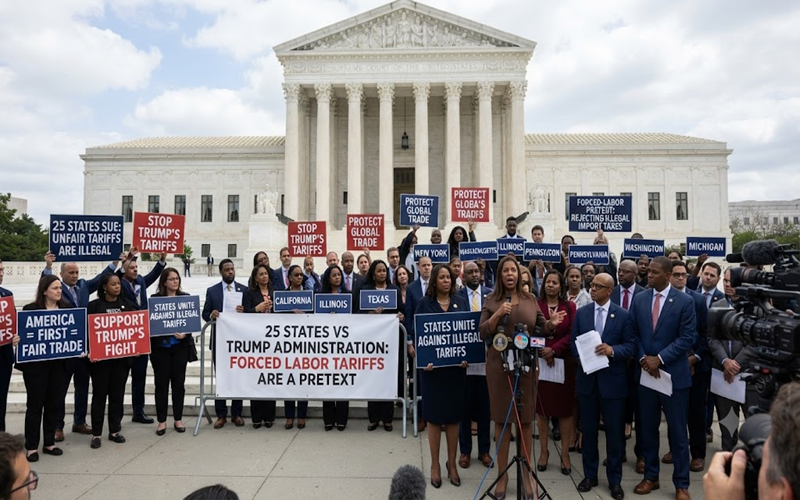
WASHINGTON, D.C. — A coalition of twenty-five states has filed a federal lawsuit against the Trump administration over its latest wave of global tariffs, contending that the measures are merely a legal maneuver to replace earlier import levies struck down by the Supreme Court.
The legal challenge targets double-digit tariffs recently enacted against 59 countries and the European Union under Section 301 of the Trade Act of 1974.
The administration justified the new duties—ranging from 10% to 12.5% and affecting nations supplying 99% of American imports—by asserting that these trading partners failed to adequately combat goods produced with forced labor.
"After losing at the Supreme Court, the administration is once again trying to illegally raise taxes on families and businesses with a new round of tariffs," stated New York Attorney General Letitia James.
New York is joined in the lawsuit by Arizona, California, Colorado, Connecticut, Delaware, Hawaii, Illinois, Kentucky, Massachusetts, Maryland, Maine, Michigan, Minnesota, Nevada, New Jersey, New Mexico, North Carolina, Oregon, Pennsylvania, Rhode Island, Virginia, Vermont, Washington, and Wisconsin.
Escalating Legal Battles Over Trade Authority
The latest lawsuit follows previous judicial setbacks for the administration's trade agenda. Earlier, the Supreme Court ruled that the International Emergency Economic Powers Act (IEEPA)—initially invoked by President Donald Trump to place sweeping tariffs on nearly all foreign imports—did not authorize import taxes, forcing federal authorities to issue refunds to importers. Temporary worldwide tariffs subsequently enacted also expired on July 24.
Legal experts note that while Section 301 is a long-standing statute successfully used during Trump's first term against Chinese imports, the administration's latest broad rollout faces unique scrutiny.
Barry Appleton, co-director of New York Law School's Center for International Law, pointed out that because these new measures represent the third consecutive attempt to impose blanket tariffs under varying statutory frameworks, their identical structure could complicate courtroom defense.
Small businesses previously initiated two separate challenges in July at the Court of International Trade, arguing that federal regulators failed to properly substantiate claims against specific economies or demonstrate how the tariffs would resolve the targeted practices, as mandated by Section 301.
Conversely, the White House defended the legality and necessity of the action.
"The United States is using its lawful authority to obtain the elimination of unreasonable acts, policies, and practices that burden U.S. commerce," said White House spokesman Kush Desai. "Section 301 tariffs have proven to be a legally durable tool since the President's first term, and they remain so now."
With the latest state-led challenge moving forward alongside existing industry suits, the judiciary will once again test the boundaries of executive trade authority and the statutory guardrails established by Congress.