

Trump’s Climate Rollback Sparks Legal Battle and Political Showdown
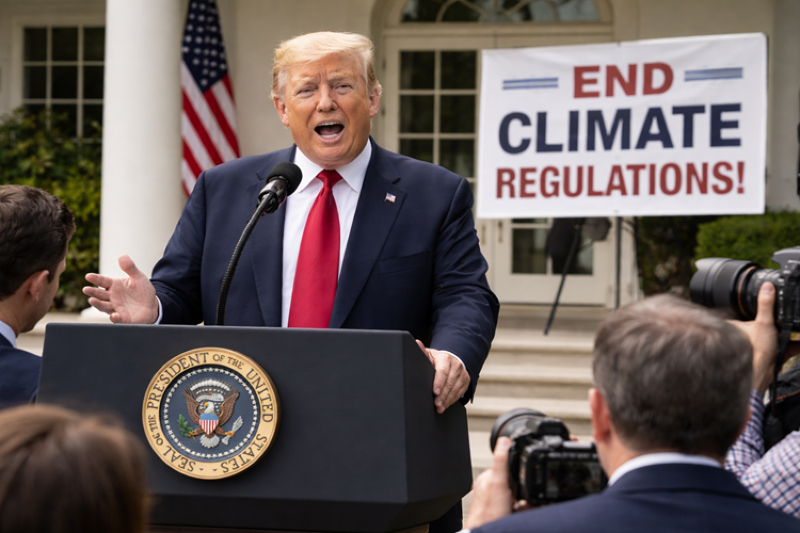
February 16, 2026: President Donald Trump’s administration has delivered the most significant shift in US climate policy in over a decade, formally revoking the 2009 “endangerment finding” that classified greenhouse gases as a threat to public health.
The decision removes the legal foundation for regulations limiting emissions from vehicles, power plants, and other major sources of pollution.
The move, hailed by the White House as a historic deregulatory achievement, is projected to save American businesses more than $1 trillion by lifting vehicle emissions standards and rolling back industry regulations.
Trump framed the repeal as a corrective measure against what he called a “disastrous Obama-era policy” that increased costs for consumers and hindered the auto industry.
Legal Battles Loom
Environmental groups and Democratic-led states have already announced plans to contest the repeal in court. The Natural Resources Defense Council (NRDC) vowed to challenge the rollback, arguing that it contravenes the Clean Air Act and threatens public health.
“We’re going to be taking this fight to the courtroom, and we are going to win,” said NRDC President Manish Bapna. Analysts anticipate that the case will eventually reach the Supreme Court, testing the limits of the EPA’s authority and potentially reshaping climate law in the United States.
Experts also predict a resurgence of public nuisance lawsuits, allowing cities, states, and communities to hold corporations accountable for the impacts of greenhouse gas emissions.
These legal actions could impose significant liabilities on fossil fuel companies and auto manufacturers, effectively challenging the administration’s deregulatory push.
Political and Industry Dimensions
The repeal has energized Trump’s allies in the fossil fuel sector, including oil, gas, and coal companies. Earlier this week, Trump welcomed coal miners to the White House, unveiling measures aimed at boosting coal production, a sector that has declined sharply under stricter environmental regulations.
Industry groups praised the decision, with the Alliance for Automotive Innovation calling it a correction to “unachievable emissions regulations.”
However, international trade experts warn that US automakers could face shrinking export markets as countries with stricter emissions standards increasingly favor electric and low-emission vehicles.
Environmental and Public Health Risks
Scientists and health experts argue that the repeal could have severe consequences for climate and human health. The National Academies of Sciences, Engineering, and Medicine has emphasized that understanding of climate risks has only grown since 2009, highlighting the danger of rising temperatures, extreme weather events, and heat-related mortality.
Environmental advocates estimate that increased emissions could lead to thousands of premature deaths, millions of asthma attacks, and billions in climate-related damages over the coming decades. California Governor Gavin Newsom warned that if the repeal survives legal challenges, the state will face worsening wildfires, floods, droughts, and heat-related deaths.
EPA’s Controversial Justification
The Trump EPA has argued that the Clean Air Act was never intended to regulate greenhouse gases because climate change is a global phenomenon rather than a localized pollutant.
The agency initially questioned the scientific consensus on climate change, citing a draft Department of Energy report criticized for bias and lack of transparency. Legal experts note that such reasoning may face strong scrutiny in the courts.
A Nation Divided on Climate Policy
The repeal has drawn fierce criticism from EPA staff and union leaders, who accused the administration of siding with “powerful corporate polluters” over public health. Justin Chen, president of the EPA’s largest staff union, called it a “deep betrayal of the EPA’s mission.”
Democratic lawmakers and environmental advocates argue that the administration’s deregulatory agenda prioritizes short-term economic gain for fossil fuel interests over long-term climate stability and public welfare.
Looking Ahead: Courtroom and Global Implications
With multiple lawsuits expected and a likely Supreme Court showdown, the repeal of the endangerment finding sets up a protracted legal and political battle.
The outcome could determine whether the US remains a global leader in climate mitigation or cedes ground to nations accelerating renewable energy adoption, particularly China and the European Union.
“This isn’t just a domestic policy fight,” said former EPA official Joe Goffman. “It’s a signal to the world that the US is stepping back from its responsibilities, and the consequences—legal, environmental, and economic—will unfold for decades.”