
New Settlement Proposed Near Jerusalem Marks First Expansion Since 1967
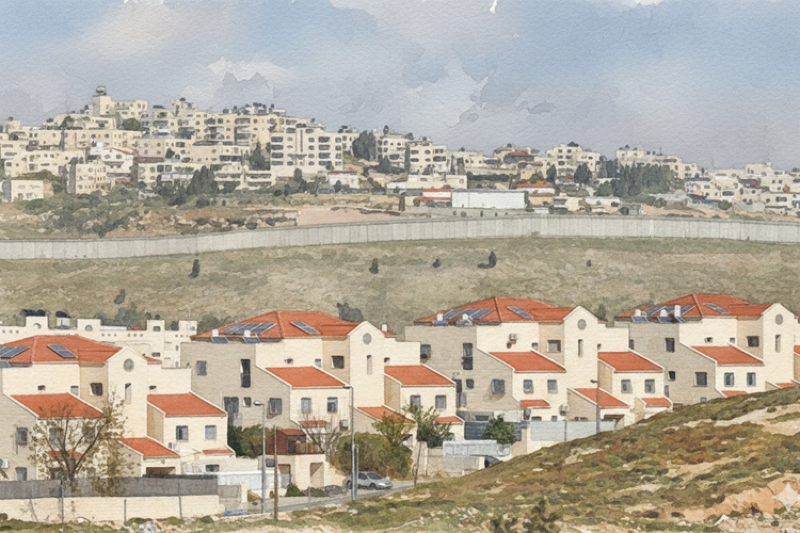
A recent agreement between the Israeli government and the West Bank’s Mateh Binyamin Regional Council could lead to the establishment of a new settlement near Jerusalem, marking what would be the first expansion of the city’s boundaries since 1967 if fully approved.
The proposed development, announced earlier this month, would technically be an extension of the existing Adam settlement, located near Jerusalem’s northeast boundary. Plans include the construction of approximately 2,780 housing units, forming a new “neighborhood” for Adam.
However, the land designated for the project is physically separated from Adam by Route 437 and the existing security barrier. As a result, the site has greater territorial continuity with the East Jerusalem neighborhood of Neve Yaakov, which lies within Jerusalem’s municipal boundaries.
While the settlement would not be formally part of Jerusalem, some municipal services may be provided by the city, according to observers.
The development is planned on roughly 500 dunams of land between the Palestinian towns of Hizma and Al-Ram. The government is expected to invest around NIS 120 million ($39 million) to support infrastructure, public spaces, and community facilities for the new neighborhood.
The plan has not yet been submitted to the Civil Administration’s Higher Planning Committee, meaning final approval could take up to two years. Nonetheless, the Housing Ministry has already begun marketing 500 units for the first phase of construction.
Reactions and Perspectives
The Housing and Construction Ministry described the agreement as a “significant step” in developing settlements near Jerusalem, providing additional housing while integrating new neighborhoods with existing communities.
Conversely, Peace Now, an Israeli organization that monitors settlements, warned that the project could be seen as an expansion of Jerusalem into the West Bank.
The group described the move as a potential “backdoor annexation,” arguing that the new settlement would function largely as a neighborhood of Jerusalem despite its official designation as part of Adam.
Democratic MK Gilad Kariv also expressed concerns, suggesting that extending municipal influence over West Bank territory could heighten regional tensions.
Meanwhile, Mateh Binyamin Regional Council head Israel Ganz welcomed the project, stating it would improve the quality of life for local residents and contribute to the broader settlement vision in the region.
As the plan moves through the approval process, its future impact on the area, housing, and regional dynamics remains under close observation.