
Dhaka’s Air Quality Plummets to ‘Very Unhealthy’ Levels
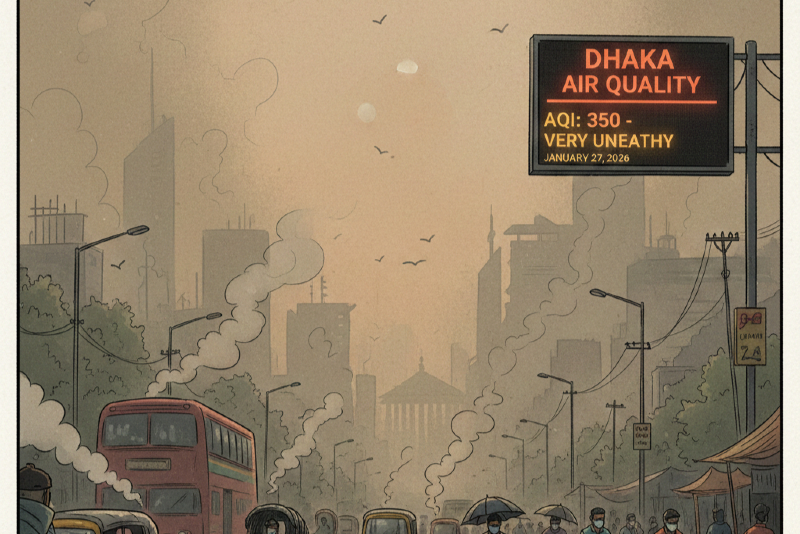
Dhaka, January 27, 2026 — The capital city’s air quality reached a critical low on Tuesday morning, solidifying its position as one of the most polluted metropolitan areas on the planet. With an Air Quality Index (AQI) of 225, Dhaka was ranked the third most polluted city globally out of 124 monitored locations, according to data from IQAir.
This "very unhealthy" designation reflects a persistent trend; Dhaka has frequently topped global pollution charts throughout December and January. While the capital remains a primary focus for environmental concerns, experts noted that New Delhi fared even worse on Tuesday, hitting a "hazardous" AQI of 314.
Pollution Hotspots in the Capital
While the citywide average is alarming, specific neighborhoods recorded even higher concentrations of pollutants. Six locations stood out for their particularly poor air quality:
Location | AQI Score | Classification |
|---|---|---|
Nikunj (ASL Systems) | 288 | Very Unhealthy |
Mirpur (Eastern Housing) | 274 | Very Unhealthy |
Dhanmondi | 258 | Very Unhealthy |
South Pallabi | 245 | Very Unhealthy |
Becharam Dewri | 235 | Very Unhealthy |
Bay’s Edge Water | 215 | Very Unhealthy |
A Growing Health and Policy Crisis
Environmental specialists warn that despite various government-led initiatives, air quality continues to decline.
An AQI reading above 200 is a serious health milestone, signaling that the general public is likely to be affected, while sensitive groups may experience more severe effects. Once the index crosses 300, the air is considered "hazardous," posing immediate risks to all residents.
Recommended Safety Measures
To mitigate the risks of respiratory and cardiovascular issues, health experts and IQAir suggest the following:
Mask Up: Always wear a high-quality mask when stepping outdoors.
Indoor Protection: Keep windows and doors tightly shut to prevent particulate matter from entering homes.
Limit Activity: Avoid outdoor exercise or strenuous physical labor until the smog clears.

The persistent nature of this smog has prompted renewed demands from the public and environmental advocates for more robust, long-term policy interventions that go beyond temporary measures.
An AQI reading above 200 is a serious health milestone, signaling that the general public is likely to be affected, while sensitive groups may experience more severe effects. Once the index crosses 300, the air is considered "hazardous," posing immediate risks to all residents.