
Bangladesh Parliament Sees Heated Exchange Over Proposed Constitutional Reform Council Under July Charter
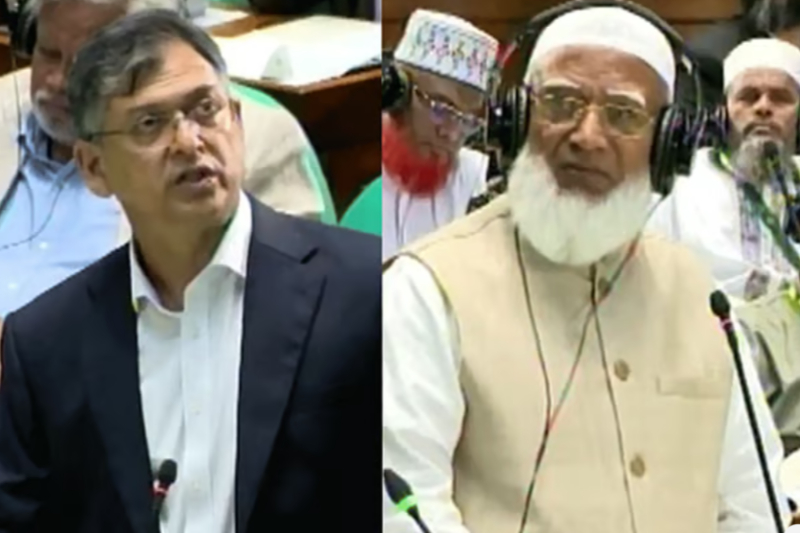
A sharp debate unfolded in the Bangladesh national parliament on Sunday between Home Minister Salahuddin Ahmed and opposition leader Shafiqur Rahman over the formation of a Constitutional Reform Council proposed under the July National Charter.
The discussion arose during an unscheduled debate in the House as the Jamaat-led opposition alliance pressed the government to implement the July Charter through parliament, while the BNP-led government argued that the current constitution does not legally permit such a move.
Opposition Raises Concern Over Delay
The issue was raised at the beginning of the parliamentary session by opposition leader and Jamaat-e-Islami Ameer Shafiqur Rahman. The session began at 11:00 a.m., and the Speaker initially asked him to wait until the end of the question-answer segment before presenting his concern.
Once given the floor, Rahman said the parliament itself was formed in the aftermath of the July uprising and through a presidential order issued on November 13, 2025, rather than through the usual constitutional electoral process.
Referring to the July National Charter (Constitutional Reform Implementation Order), Rahman read out sections of the document and stated that it clearly requires the Constitutional Reform Council to convene within 30 days after the declaration of election results.
According to him, the deadline has already passed without any session being called.
“This is a matter of concern,” Rahman told the House.
Dual Mandate of Members
The Jamaat chief further argued that the elected members of parliament had been chosen through two separate voting mandates under the July order—one as legislators and another as members of the proposed Constitutional Reform Council.
He said 77 opposition members had already taken oath as members of the council in accordance with the July order.
“These representatives want to perform their responsibilities simultaneously as members of parliament and as members of the Constitutional Reform Council,” Rahman said.
He also argued that the procedure for convening the council should follow the same mechanism used to summon parliament—namely a presidential summons issued on the advice of the prime minister.
Government Questions Procedural Validity
Responding to the opposition leader, Home Minister Salahuddin Ahmed first questioned the procedural basis on which Rahman had been allowed to raise the issue.
He asked the Speaker under which rule the floor had been granted and whether the opposition had submitted the required notice for an adjournment motion or a short discussion under Rule 68 of parliamentary procedure.
Ahmed then turned to the constitutional issue itself, arguing that the July Charter implementation order does not fit within existing legal categories.
“This order is neither an ordinance nor an act of parliament,” he said. “It is something in between—what I earlier described as a kind of ‘neutral gender’ instrument.”
Government: Constitution Does Not Recognize Such a Council
The home minister said the core obstacle is that the existing constitution does not recognise any body called a Constitutional Reform Council.
Under constitutional provisions, the president performs most duties on the advice of the prime minister, including summoning parliament. However, because the constitution does not mention such a council, the prime minister cannot advise the president to call its session.
“For that reason the president has not convened it,” Ahmed told lawmakers.
He also described the July Charter implementation order as an “imposed directive”, suggesting it had been introduced outside normal constitutional processes.
Court Scrutiny and Legal Concerns
Ahmed noted that the judiciary has already taken notice of legal challenges surrounding the order.
He said a court has issued a rule asking why certain provisions of both the July Charter implementation order and the referendum ordinance should not be declared unconstitutional.
While acknowledging that the judiciary may express its opinion, the minister emphasized that parliament remains sovereign.
“However, parliament cannot pass any law that may later be struck down by the courts for violating the constitution,” he said.
Debate Over Referendum Mandate
The minister also questioned the structure of the referendum that followed the July Charter.
According to him, voters were presented with four questions, including a major one relating to the charter itself, but they were not given the option to approve or reject individual questions separately.
He described the process as a forced or imposed arrangement, even though the government still recognizes the importance of respecting public opinion.
Government Suggests Constitutional Route
Ahmed said that if the referendum verdict is to be implemented, constitutional amendments must first be adopted through parliament.
He expressed doubt that such amendments could be introduced immediately because 133 ordinances were placed before parliament on the first day of the session.
Instead, he suggested the matter could be taken up in the budget session, depending on the decision of the parliamentary business advisory committee.
“We must respect the people’s mandate, but it must be done constitutionally and legally,” he said. “The state does not operate on emotion; it operates through law and the constitution.”
Opposition Pushes for July Charter Implementation
The Jamaat-led 11-party opposition alliance has been pressing for the full implementation of the July Charter, arguing that it represents a political consensus reached after the July uprising and subsequently endorsed through referendum.
They believe the Constitutional Reform Council should begin functioning immediately to draft structural changes to the constitution.
Speaker Calls for Formal Proposal
After hearing both sides, Speaker Hafiz Uddin Ahmed said the matter was too significant to be resolved instantly during a spontaneous debate.
“You have raised an issue of great public importance,” the Speaker told the opposition leader. “Such matters cannot be decided on the spot. Submit a formal notice, and I will take a decision after receiving it.”
The exchange highlighted the growing political divide between the opposition bloc pushing for the July Charter’s immediate parliamentary implementation and the BNP-led government insisting that any reform must first align with the existing constitutional framework.