WASHINGTON D.C.
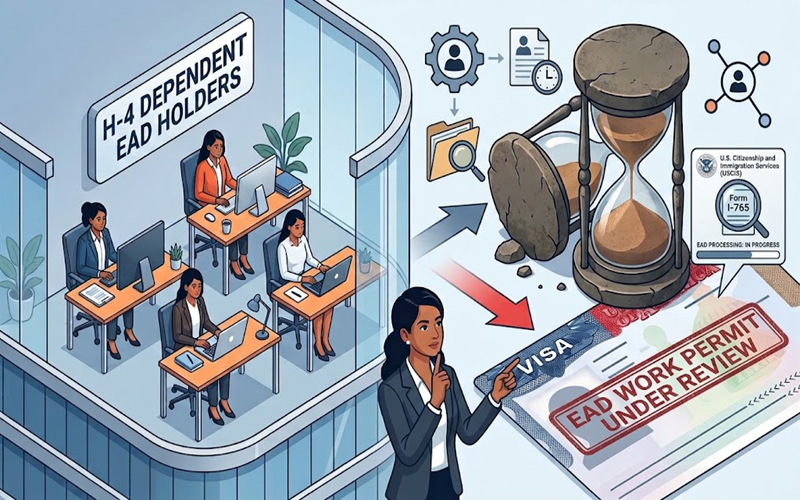
The regulatory action item, registered under tracking code RIN 1615-AD14, targets the 2015 Obama-era provision that allowed spouses of H-1B skilled worker visa holders to apply for Employment Authorization Documents (EADs) while their families await lawful permanent residency (green cards).
The Scope of the Regulatory Proposal
The new listing on the federal 2026 Unified Agenda seeks to reverse a decade-old regulation that permits qualified H-4 spouses to secure legal jobs in the United States.
Under current rules (8 C.F.R. § 274a.12(c)(26)), H-4 spouses can apply for work permits if their primary H-1B spouse has an approved Form I-140 immigrant petition or has secured extensions past the traditional six-year H-1B limit due to massive green card backlogs.
The proposed DHS measure explicitly aims to restore the pre-2015 policy framework, under which dependent spouses were strictly barred from obtaining legal work authorization.
Immediate Impact and Legal Timeline: What Permits Remain Valid?
Immigration attorneys emphasize that the proposal does not cancel existing H-4 work permits immediately.
Current Status:
The item is currently classified under "Long-Term Actions" with an anticipated Notice of Proposed Rulemaking (NPRM) date listed as "To Be Determined". Procedural Safeguards: To become enforceable, DHS must first publish a draft rule in the Federal Register, open a mandatory public comment period (typically 30 to 60 days), address administrative feedback, and issue a final rule.
Validity of Existing EADs: Foreign professionals with valid, unexpired H-4 EADs are legally authorized to continue working under existing regulations.
Who Stands to Suffer the Greatest Impact?
The proposed rollback disproportionately affects families from South Asia, particularly Indian expatriates.
Demographic Concentration: Historical data from U.S. Citizenship and Immigration Services (USCIS) shows that approximately 93% of all approved H-4 EAD applications belong to Indian nationals, with over 94% of these permit holders being women holding higher-education degrees.
Green Card Backlogs:
Due to per-country statutory limits on employment-based green cards, Indian professionals often face decades-long wait times for permanent residency. Spousal work authorization serves as a crucial economic stabilizer for families enduring these prolonged administrative delays. Corporate Exposure: Affected professionals are heavily concentrated in the U.S. technology, healthcare, finance, and engineering sectors, raising concerns among business groups regarding sudden talent drain and household financial strain.
Legal and Economic Hurdles Ahead
This marks a revival of previous attempts to dismantle spousal work authorizations.
Legal experts point out that any formal move to eliminate the H-4 EAD will likely face significant administrative challenges:
Federal Judicial Precedent: In August 2024, the U.S. Court of Appeals for the D.C.
Circuit upheld DHS's authority to grant work permits to H-4 spouses, a decision the U.S. Supreme Court declined to overturn in late 2025. Economic Reliance Costs:
Under the Administrative Procedure Act (APA), rescinding a long-standing policy requires DHS to substantiate its decision with detailed economic impact analyses, proving how removing tens of thousands of active workers benefits the domestic market without causing severe reliance damages to businesses and local economies.