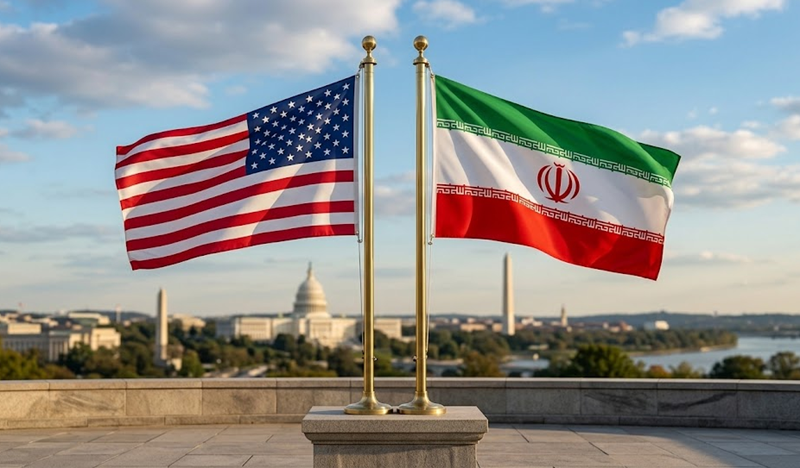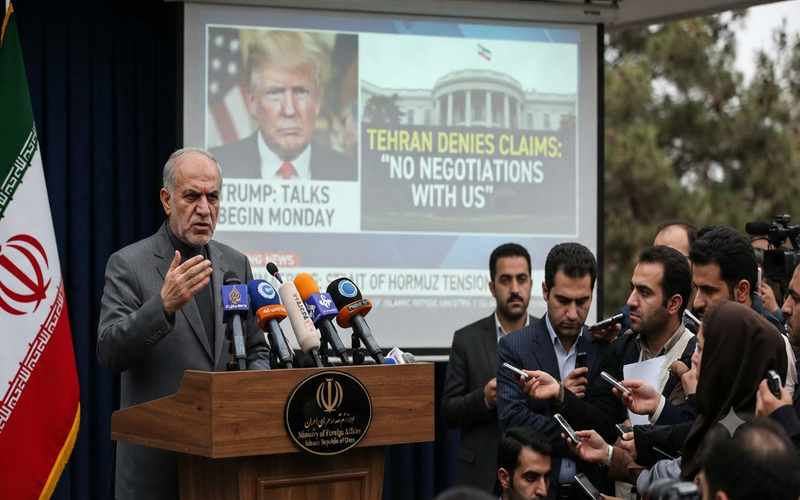
Iran has formally rejected claims by US President Donald Trump that structured bilateral discussions aimed at concluding the ongoing conflict would commence on Monday.
The disagreement follows statements made by President Trump aboard Air Force One, where he asserted that a massive prospective bombing campaign against Iran had been halted because regional allies and Iranian channels indicated a willingness to compromise. According to Trump, both sides were primed for structured talks to begin following agreements regarding the security parameters of the Strait of Hormuz.
However, Iranian Foreign Ministry spokesperson Esmaeil Baghaei explicitly refuted the assertion, stating that Tehran is not engaged in direct negotiations with the United States. Baghaei clarified that limited diplomatic channels are active solely with Oman to establish navigational understandings for commercial shipping lanes in the Gulf, rather than addressing broader geopolitical terms with Washington. A semi-official statement from Iran's Mehr news agency further dismissed the American narrative, branding the remarks as completely unfounded.
Market Shifts and Regional Mediation
President Trump credited regional leaders—including Saudi Crown Prince Mohammed bin Salman, alongside officials from Qatar and the United Arab Emirates—with urging him to hold off on further military escalations over the weekend. Trump stated that the averted strikes would have constituted one of the largest coordinated operations of the modern era, adding that he chose restraint to preserve prospects for a long-term diplomatic off-ramp.
News of the cancelled strikes and prospective dialogue provided an immediate, albeit volatile, reaction in global markets. Brent Crude dropped by 4.5% to settle near $83.98 per barrel, while US benchmark crude fell roughly 4.6% to $80.74 amidst persistent supply anxieties.
Energy analysts continue to monitor maritime traffic closely through the Strait of Hormuz, through which roughly a fifth of global petroleum and liquefied natural gas passes. Intelligence data indicates that commercial transit through the chokepoint has slowed notably, recording a nearly 28% drop in crossings over a recent four-day window compared to prior averages.
Domestic Pressure and Intermittent Diplomacy
Despite repeated assertions from the White House that a diplomatic breakthrough is imminent, previous attempts at face-to-face negotiations—including high-profile mediation efforts led by US officials—have repeatedly stalled over core disagreements regarding Iran's nuclear development and regional security posture.
Domestically, the protracted conflict continues to face political scrutiny. Public polling data highlighting economic strain and war fatigue has raised concerns among political strategists regarding the administration's standing heading into the upcoming midterm elections.
As military readiness remains high on both sides, Iranian acting Defense Minister Majid Ibn al-Reza emphasized that Tehran treats every hostile posture as an active threat, signaling that military forces remain fully mobilized regardless of shifting diplomatic messaging.