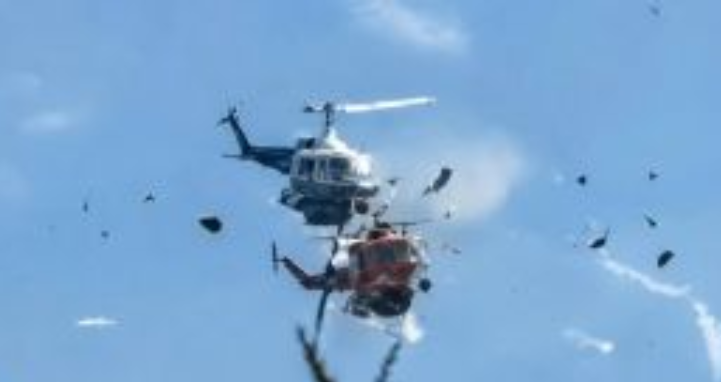
ATHENS — A tragic mid-air collision between two firefighting helicopters on the Attica-Boeotia border in Greece has resulted in the deaths of two crew members, according to local authorities.
The fatal accident occurred approximately 65 km (42 miles) west of Athens as the leased Bell helicopters were engaged in suppressing active wildfires in the region. Footage capturing the moments before the crash shows one aircraft striking the rotors of the other, causing it to burst into flames and crash into a ravine.
Casualties and Survivors
The two individuals who lost their lives were identified as a Danish pilot and a Greek fire service liaison officer. Meanwhile, the second aircraft managed to perform an emergency landing in a low-vegetation area. Its crew—comprising a British private pilot hired for the wildfire season and a Greek co-ordinator—escaped with minor injuries and were hospitalized as a precaution. Greek media reported that the survivors immediately alerted authorities, helping guide rescue teams directly to the crash site.
In response to the disaster, civil protection sources confirmed that all Bell helicopters nationwide have been grounded pending investigation protocols. Other heavy aerial assets, including Erickson Air-Crane, Chinook, and Canadair water-bombing planes, continue to support operations.
Broader European Wildfire Crisis
Greek Prime Minister Kyriakos Mitsotakis shared his deepest sorrow on social media, offering condolences to the grieving families of the deceased crew members.
More than 500 firefighters have been locked in a grueling battle over a 72-hour period across multiple fronts, including Porto Germeno, Psatha, Fokida, Megara, and Kefalonia. While major blazes previously threatening Madrid and Bordeaux have recently been contained—allowing roughly 300,000 evacuees to begin returning home—southern Europe remains heavily strained.
Experts note that while most fires are ignited by human actions, unseasonably mild and wet winter conditions followed by intense summer heatwaves have generated severe vegetation overgrowth, creating an abundance of dry fuel that continues to drive explosive wildfire behavior across the continent.