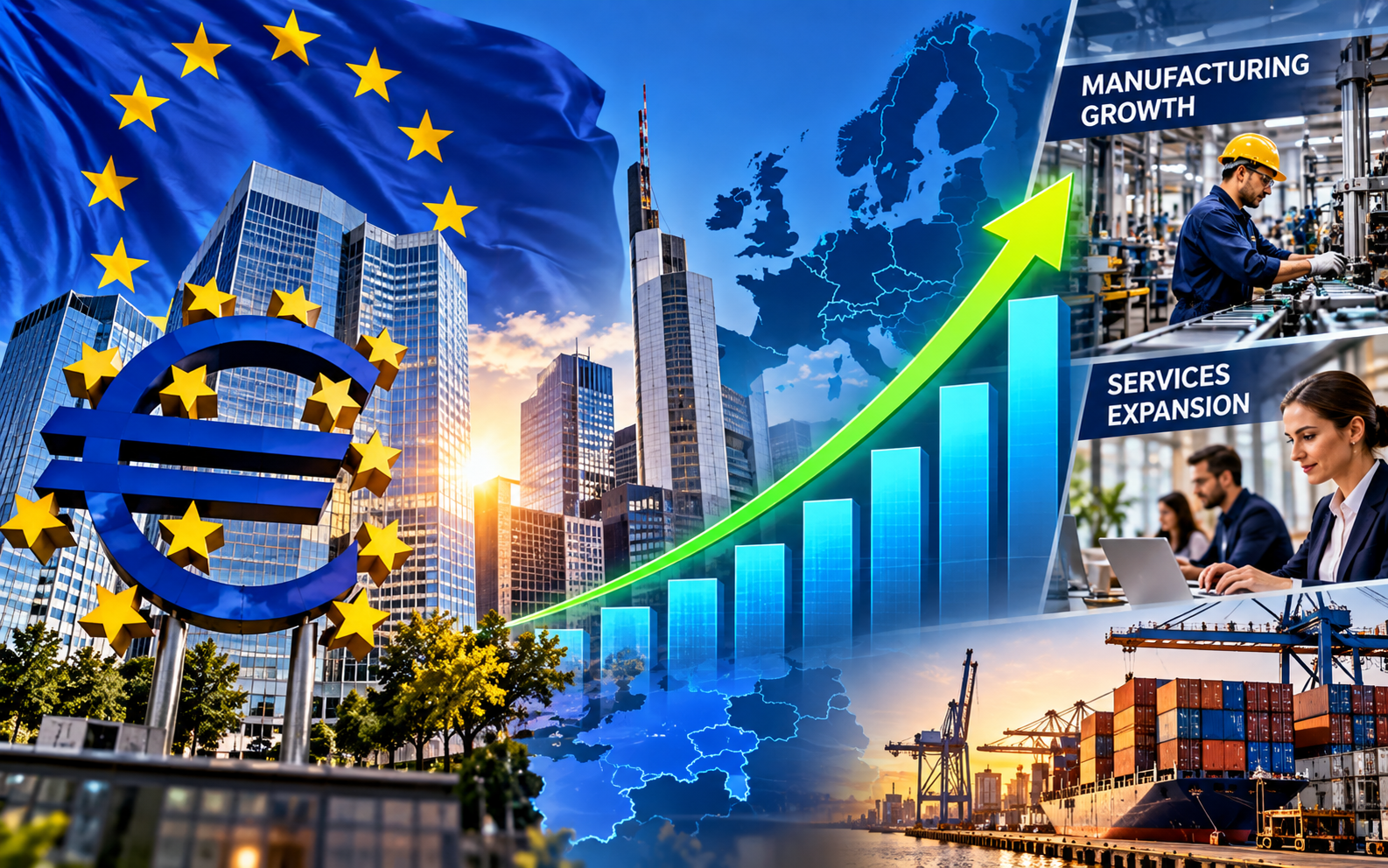
BRUSSELS — Business activity across the eurozone accelerated sharply in September, reaching its strongest level in more than three years as both manufacturing and services recorded solid growth despite higher energy costs and persistent geopolitical uncertainty.
Preliminary data from S&P Global showed that the HCOB Flash Eurozone Composite Purchasing Managers’ Index (PMI) climbed to 53.1 in September from 52.0 in August. It was the highest reading since April 2023 and considerably stronger than economists had expected.
A PMI reading above 50 indicates expansion, while a figure below that level signals contraction.
The September figures marked the third consecutive month of expansion in eurozone business activity and suggested that the region’s economy is proving more resilient than anticipated in the face of geopolitical tensions and rising costs. S&P Global said the survey data were consistent with quarterly economic growth of around 0.4%.
The improvement was spread across both major sectors of the economy. Services activity rose to 53.0 from 51.6 in August, reaching a 10-month high. The manufacturing PMI remained at 52.7, while the manufacturing output index edged higher to 53.4, its strongest reading in more than four and a half years.
Demand also strengthened significantly. New orders increased for a third consecutive month and at their fastest rate since May 2022.
Export orders, which include trade between eurozone countries, rose for a second successive month after a prolonged period of weakness. Companies responded to improving demand by modestly increasing employment.
The recovery was also visible in the eurozone’s two largest economies. Germany recorded its strongest private-sector expansion in almost a year, supported particularly by manufacturing.
France, meanwhile, returned to growth after months of contraction, providing another indication that the recovery was becoming more broadly based across the currency bloc.
S&P Global said stronger manufacturing activity has been supported partly by increased spending on artificial intelligence and defence, while services have also gained momentum.
The improvement in order books across both sectors suggests that economic activity could remain relatively firm heading into the final quarter of the year.
However, the stronger economic performance has been accompanied by renewed inflationary pressure.
Businesses reported faster increases in both input costs and selling prices in September, with higher energy costs linked to the continuing Middle East conflict adding to companies’ expenses.
The combination of stronger growth and rising prices could influence the European Central Bank’s next monetary policy decisions.
The ECB has already raised interest rates twice this year amid energy-driven inflation, and the latest economic data could strengthen expectations of further monetary tightening.
The improved business figures coincide with a more positive assessment of the eurozone economy from the Organisation for Economic Co-operation and Development.
The OECD raised its forecast for euro-area economic growth in 2026 by 0.2 percentage points to 1%, while also upgrading projections for Germany, Italy and Spain. Its outlook for France, however, was lowered, with growth there now projected at 0.4%.
Despite the stronger September performance, uncertainty remains over whether the momentum can be sustained as households and businesses contend with elevated prices, higher borrowing costs and geopolitical risks.
For now, however, the latest PMI figures indicate that the eurozone economy entered the final months of 2026 with considerably stronger business activity than economists had anticipated.