
Worsening Gas Shortfall Threatens Stability as Experts Push Clean Energy Transition
Dhaka, Feb 3, 2026: Bangladesh’s deepening gas shortage could trigger widespread economic disruption and social stress unless urgent corrective steps are taken, experts warned on Monday, urging immediate demand-management measures and a long-term shift toward renewable energy to stabilise the power sector.
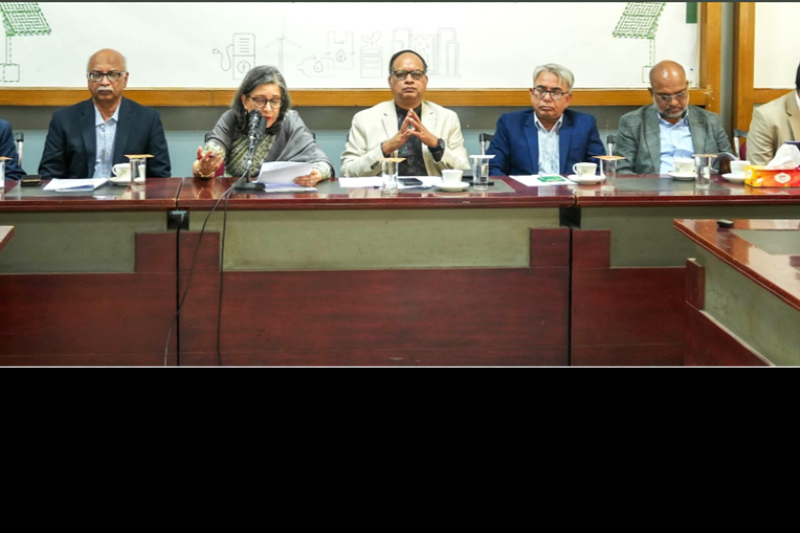
Energy specialists and civil society representatives made the remarks at a press conference in Dhaka, saying the country’s continued dependence on imported fossil fuels has increased costs, weakened energy security and left the economy exposed to global market shocks.
“Hard to Manage, Painful for All”
Prof M Tamim, vice-chancellor of Independent University, Bangladesh (IUB), cautioned that managing the gas deficit would become increasingly difficult if decisive action is delayed, with consequences felt across households, industries and public services.
He was speaking at the event titled “Reclaiming Power: A Just Energy Transition for Bangladesh”, held at the National Press Club and organised by the Just Energy Transition Network Bangladesh (JETnet-BD), a platform comprising 155 civil society organisations, with ActionAid Bangladesh acting as secretariat.
As an immediate response to ease strain on the power system, Prof Tamim proposed revising office schedules to reduce peak electricity demand. Earlier working hours, he said, could help lower evening consumption when the national grid is under maximum pressure.
Lack of a Unified Energy Strategy
While short-term measures may offer relief, Prof Tamim stressed that Bangladesh urgently needs a coherent national framework to guide its energy transition. He endorsed JETnet-BD’s 14-point Citizens’ Manifesto, noting that the country still lacks a truly integrated policy for moving toward clean energy.
He also pointed out that government engagement in renewable energy development remains limited, particularly during transitional phases, warning that ambitious targets would be difficult to reach without strong public-sector leadership.
Prof Tamim highlighted inconsistencies across key policy documents, including the 2008 Renewable Energy Policy, the Eighth Five-Year Plan and the draft Renewable Energy Policy 2025, saying the lack of alignment reflects weak coordination at the policymaking level.
Doubts Over Long-Term Targets
Dr Ijaz Hossain, an energy expert and former professor at Bangladesh University of Engineering and Technology (BUET), expressed concern over the country’s current renewable energy direction, saying he remained unconvinced that existing targets were achievable under present conditions.
He warned that even goals set for 2060 could remain unmet without serious improvements in planning and execution. Dr Hossain also criticised the opacity of policy decisions, claiming that key stakeholders are often excluded from meaningful consultation. He urged continued public scrutiny of energy policies.
Rising Costs from Fuel Imports
Speakers at the press briefing drew attention to the financial burden of fossil fuel dependence, noting that about 97 per cent of Bangladesh’s energy demand is met by fossil fuels, nearly 70 per cent of which are imported.
This reliance costs the country an estimated Tk 1.5 trillion each year and leaves the economy vulnerable to international price fluctuations, they said.
Shafiqul Alam, chief analyst at the Institute for Energy Economics and Financial Analysis (IEEFA), said electricity generation costs averaged Tk 12.10 per unit in fiscal year 2024–25.
Oil-fired power plants accounted for 10.7 per cent of total generation, he added, noting that replacing even a small portion of oil-based power with renewables could significantly reduce overall costs.
Calls to Review Power Deals
M Zakir Hossain Khan, executive director of Change Initiative, criticised the interim government for delaying decisions on disputed power agreements involving firms such as Adani and Summit, despite allegations of irregularities. He called for the immediate termination of contracts that pose financial and energy-security risks.
Roadmap for a Just Transition
ActionAid Bangladesh also presented a 14-point Citizens’ Manifesto at the event, outlining a roadmap for a just and inclusive energy transition.
The manifesto calls for achieving net-zero carbon emissions by 2050, generating at least 20 per cent of electricity from renewable sources by 2030 and 50 per cent by 2040, alongside the gradual phase-out of import-dependent fossil fuel plants.
Additional demands include adopting a comprehensive National Energy Transition Policy, strengthening the Bangladesh Energy Regulatory Commission as an independent body, granting temporary tax exemptions on renewable energy equipment and ensuring greater use of local expertise in energy planning.
Farah Kabir, country director of ActionAid Bangladesh, said the manifesto would be submitted to political parties and election candidates ahead of the next national polls.
“Bangladesh’s challenge is not energy scarcity,” she said. “The real challenge is building a sustainable, affordable and people-focused energy system that delivers security and climate justice.”