
IOC Mandates Biological Female Category for 2028 Los Angeles Olympics
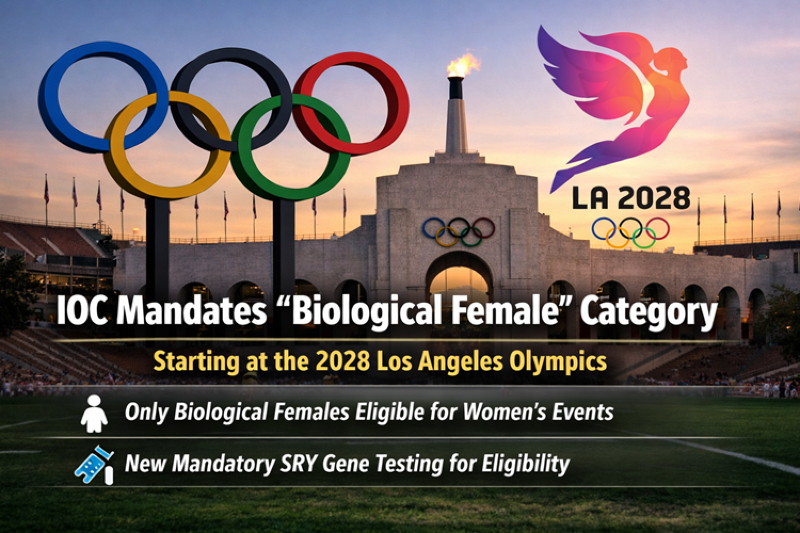
In a landmark shift for international athletics, the International Olympic Committee (IOC) has announced that the women's category in the Olympic Games will be restricted to biological females starting with the 2028 Los Angeles Games.
The decision, announced on March 26, 2026, introduces a universal eligibility standard that effectively ends the previous era of sport-specific regulations.
Medical Experts Drive New "Once-in-a-Lifetime" Testing
The new policy is centered on a "once-in-a-lifetime" screening process designed to identify the SRY gene (the sex-determining region Y gene). This gene, typically found on the Y chromosome, triggers the development of male physical characteristics. Under the new guidelines, athletes who test negative for the SRY gene via a non-intrusive saliva, cheek swab, or blood test will permanently satisfy the criteria for the female category.
IOC President Kirsty Coventry, who was elected to the role one year ago, emphasized that the policy was developed in close consultation with medical and sports science experts. "In the Olympic arena, the smallest margins determine the podium," Coventry stated. "It is fundamentally clear that allowing biological males to compete in the female category compromises both fairness and, in high-impact sports, physical safety."
Impact on Transgender and DSD Athletes
This universal ban marks a significant departure from previous years when the IOC allowed individual sporting bodies to set their own testosterone-based limits. The 2028 mandate will prevent transgender women and athletes with Differences in Sexual Development (DSD)—such as those with XY chromosomes—from entering the women's division.
Historically, athletes with DSD conditions could compete if they maintained suppressed testosterone levels. This new ruling, however, creates a definitive boundary based on genetic markers rather than hormonal fluctuations.
Inclusion Through Open and Male Classifications
While the female category becomes more restricted, the IOC stressed its commitment to broader inclusion. Athletes who do not meet the female eligibility criteria remain fully eligible to compete in:
The Male Category: All athletes, regardless of the test results, qualify for male classifications.
Mixed Events: Athletes can occupy designated male slots within mixed-gender teams.
Open Categories: The IOC encouraged the development of "open" events where classification is not determined by biological sex.
A Unified Standard for Global Sport
Until today, the landscape of elite sports was a patchwork of conflicting rules. While governing bodies for swimming, athletics, and cycling had already implemented strict biological bans, other sports still utilized testosterone-suppression models.
By implementing a centralized, genetic-based standard, the IOC aims to provide long-term "legal and competitive certainty" for female athletes. As the world looks toward Los Angeles 2028, this policy is expected to ignite intense debate regarding the balance between the "spirit of inclusion" and the "integrity of fair competition."