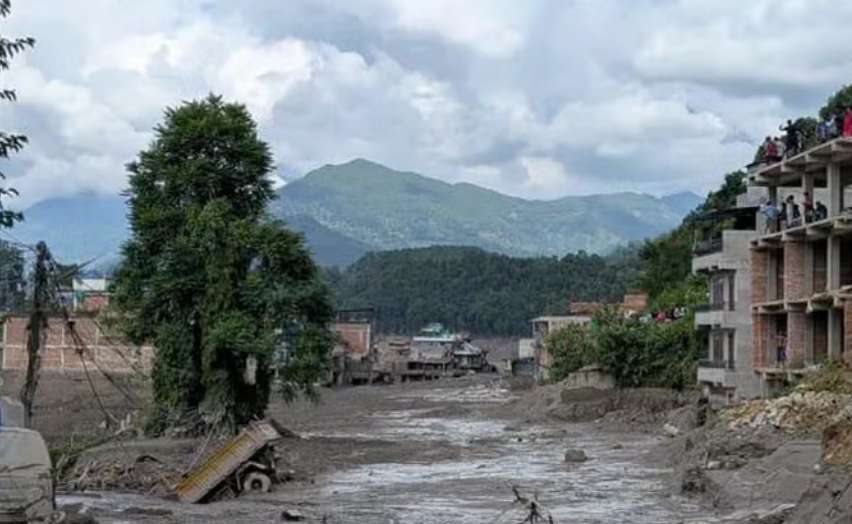
KATHMANDU- The death toll from catastrophic flash floods along the Nepal-China border has exceeded 1,000, according to official statements from disaster management authorities.
Over 3,900 people remain missing, with deep concern centered on more than 600 workers feared trapped inside mud-caked underground passages at hydroelectric facilities near the Trishuli River.
In an effort to keep any survivors alive, response teams have been pumping oxygen into the subterranean networks.
However, initial search parties that succeeded in entering one of the tunnels were forced to fall back after finding no occupants inside.
Nepalese Prime Minister Balendra Shah confirmed that 279 individuals have been successfully extracted from affected project sites so far.
A multinational emergency response—led by military crews from Nepal and China, alongside technical specialists from India, South Korea, and Australia—is coordinating complex search efforts.
In several locations, rescue workers have been compelled to use explosives to clear rocky hillsides and gain access to submerged subterranean entry points.
Nepal's economy relies heavily on its hydroelectric sector, having developed numerous power stations across its mountain river basins.
Official reports indicate that at least 11 projects—either active or under construction—suffered severe structural damage in the deluge.
While air pumping operations began over the weekend, relatives of the missing have voiced frustration, arguing that life-support measures should have been initiated sooner.
Distraught family members waiting near the disaster zones expressed fading hope as hours pass, urging authorities to accelerate excavation speed.
Acknowledging the immense scale of the crisis, Prime Minister Shah described the disaster as an extraordinary event linked to climate vulnerabilities in the Himalayan belt, calling for stronger international action on climate-induced natural disasters.
Technical advisers on the scene noted that heavy mudflows have completely erased the visual entrances to several power facilities, turning the landscape into a vast expanse of silt and massive boulders.
Downstream in districts like Chitwan, local authorities have resorted to temporary mass burials after hundreds of unidentified bodies washed ashore.
Medical teams and volunteers are extracting DNA samples prior to burial so that grieving families can officially identify and claim the remains of their loved ones in the future.