DHAKA — Behind the promise of international curricula and English-language education, a growing number of parents are raising questions about the cost, teaching standards and academic practices of some English-medium schools in Dhaka.
Parents interviewed for this report alleged that despite charging comparatively high tuition and other fees, some schools rely heavily on teachers educated in the Bangla-medium system, pay relatively low salaries, prescribe expensive books and impose financial conditions that place considerable pressure on families.
They also questioned whether the education their children receive always corresponds with the international standard suggested by the “English-medium” label.
Farhan Ahmed, a father of two schoolchildren, said parents were paying premium fees because they expected a distinctly international standard of education.
“We are not questioning a teacher simply because he or she studied in Bangla medium. The question is whether the teacher has been properly trained to deliver an international curriculum,” he said.
That distinction is important. A teacher’s Bangla-medium educational background alone does not establish poor teaching ability. Parents said their concern was about recruitment standards, subject knowledge, English proficiency, training and familiarity with Cambridge or other international curricula.
Sadia, a graduate of the English Department at Khulna University, said she once sat for a teacher recruitment test at an English-medium school in Bashundhara Residential Area.
According to Sadia, she qualified in the recruitment process but was offered a monthly salary of only Tk 15,000. “I did not join,” she said.
Her account raises a wider question about whether low salary structures at some schools discourage highly qualified graduates from entering or remaining in teaching.
Nusrat Jahan, a mother, alleged that parents ultimately bear the consequences.
“When schools try to minimise expenditure on teachers while charging parents substantial fees, we naturally ask where the money is going,” she said. “Many families then have to spend again on private tutors or coaching because their children are not adequately prepared at school.”
Several parents similarly claimed that they had resorted to supplementary tuition or coaching to prepare children for examinations.
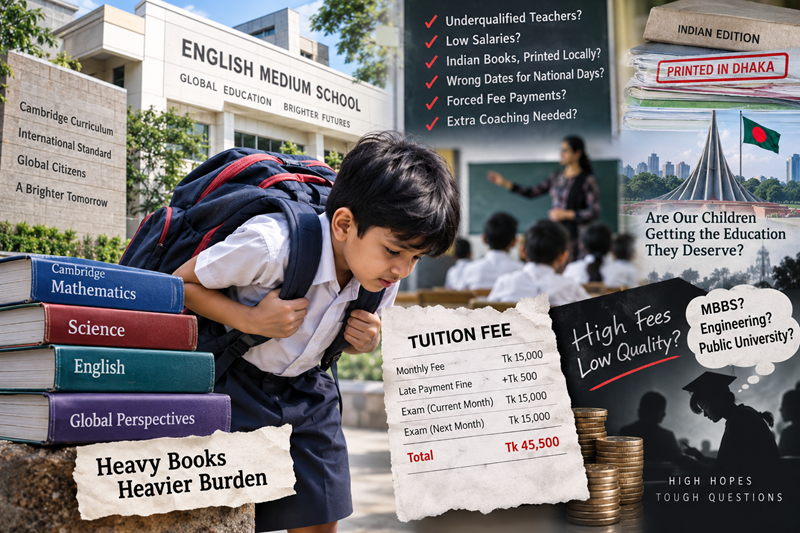
Parents also complained about the cost and physical weight of textbooks. They alleged that some books marketed or prescribed for international curricula are locally printed or reproduced on unusually heavy paper, making school bags burdensome for young children.
Sharmin Akter, whose child attends primary school, said the issue had repeatedly been brought to school authorities.
“The bag is extremely heavy for a small child. We have requested the school to reduce the number or weight of books, but we have not seen a satisfactory solution,” she alleged.
The provenance and licensing status of individual books would need to be verified with publishers, curriculum providers and schools. Local printing by itself does not establish that a book is unauthorised or inconsistent with a foreign curriculum.
Financial practices are another source of resentment.
Parents alleged that some institutions impose fines of several hundred taka when monthly tuition is not paid by around the middle of the month. More seriously, several claimed that ahead of half-yearly and final examinations they were required to clear fees for both the current and following month before their children could sit examinations.
Mahmudul Hasan, a father, described such practices as particularly stressful for middle-income families.
“A parent may be only a few days late because of salary or business circumstances,” he said. “The child should not feel that his or her examination depends on a financial dispute between adults.”
Tasnim Rahman, another mother, said tuition was only part of the financial burden, citing books, transport, uniforms, activities, coaching and other educational expenses.
Parents also questioned how some schools observe national occasions. They alleged that programmes marking Victory Day, Independence Day and Pahela Baishakh are sometimes held on dates other than the official observance days.
They argued that young children may become confused unless schools clearly teach the actual historical dates, even when programmes are rescheduled for practical reasons. Whether individual schools have violated any government directive would require examination of the applicable rules and each school's calendar.
Another less-discussed burden, parents said, is the amount of time families must devote to school transportation. Traffic congestion, limited school transport and arrangements requiring parents or attendants to accompany children can leave some guardians occupied from arrival until dismissal, affecting jobs, businesses and household responsibilities.
An education researcher, speaking generally about international-curriculum schooling, said the key indicators of quality should include teacher qualifications and training, classroom delivery, curriculum compliance, assessment practices, student outcomes and transparent fee structures—not merely a school's English-medium branding.
Claims about university admission outcomes also require reliable data. Some parents believe English-medium pupils are disadvantaged in admission to MBBS, engineering and public universities, but a nationwide comparison of admission rates by schooling background would be necessary before drawing such a conclusion.
The allegations point to a broader accountability question: what exactly are families receiving in return for the premium they pay?
Parents are calling for greater transparency in teacher recruitment and salaries, textbook sourcing, fee structures, examination-related payment policies, school-bag loads and compliance with education regulations.
For a sector built substantially on parents' aspirations for internationally benchmarked education, they say the answer cannot simply be a foreign curriculum name on the prospectus. Schools must be able to demonstrate that the quality delivered inside classrooms justifies both that description and the price families are being asked to pay.